Iterative Repair Loops with Codex CLI: The Review-Repair-Validate Pattern for Self-Correcting Agent Workflows
Iterative Repair Loops with Codex CLI: The Review-Repair-Validate Pattern for Self-Correcting Agent Workflows
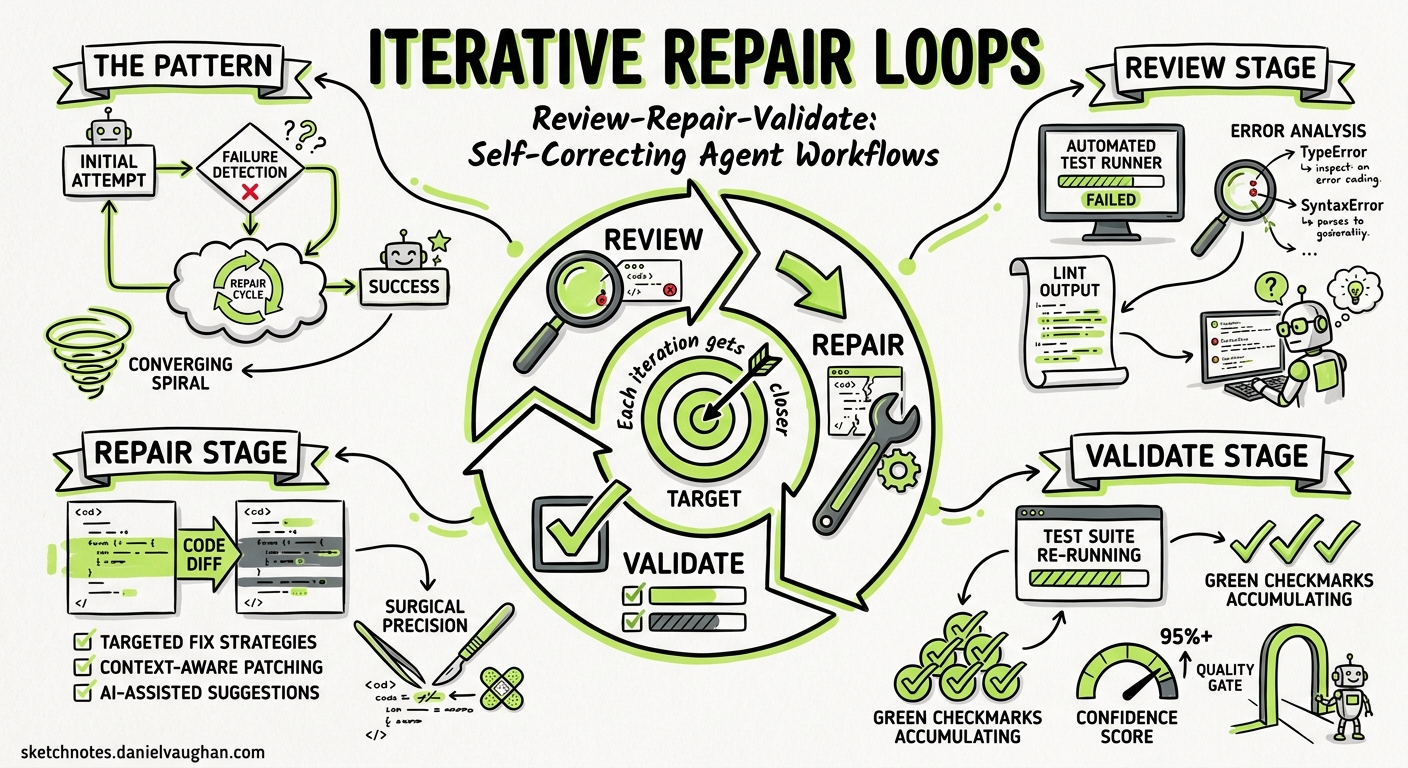
Single-pass agent runs are fragile. Hand an agent a migration task or a documentation refresh, and the first attempt will typically get 70–80% of the way there — then stall on edge cases that only surface when you actually run the tests. The fix is not a better prompt; it is a better loop.
On 11 May 2026, OpenAI published a cookbook entry formalising what practitioners have been building in shell scripts for months: the iterative repair loop — a three-phase cycle of Review, Repair, and Validate that drives agent output towards correctness through structured feedback rather than hope 1. This article breaks the pattern down, maps it onto codex exec, and shows how to wire it into CI pipelines today.
Why Single-Pass Fails
A single codex exec invocation treats the agent as a function: prompt in, artefact out. That works for bounded tasks — generating a commit message, summarising a diff — but falls apart when:
- The task has implicit validation criteria (tests must pass, linter must be clean, API contracts must hold).
- The artefact is large enough that the agent cannot hold every constraint in working memory simultaneously.
- Feedback is only available after execution — you cannot know whether the migration compiles until you compile it.
The industry consensus in 2026 is that agents perform significantly better inside a structured harness than in raw chat mode 2. The iterative repair loop is the simplest such harness worth building.
The Three-Phase Architecture
flowchart TD
    A[Artefact] --> B[Review Phase]
    B -->|Structured findings JSON| C[Repair Phase]
    C -->|Updated artefact + change summary| D[Validate Phase]
    D -->|All checks pass| E[Done]
    D -->|Remaining delta| C
    D -->|Max iterations reached| F[Human Handoff]
    D -->|No improvement detected| F
Each phase is a separate codex exec invocation with its own prompt and --output-schema, connected by machine-readable JSON rather than prose 1.
Phase 1: Review
The review phase inspects the current artefact without editing or executing anything. It returns structured findings — an array of issues, each with a severity, description, and suggested fix direction 1.
codex exec \
  --output-schema ./schemas/review-findings.json \
  -o ./state/findings.json \
  "Review $ARTEFACT against these business rules: $RULES. \
   Return structured findings. Do not edit any files."
The schema enforces machine-readable output:
{
  "type": "object",
  "properties": {
    "findings": {
      "type": "array",
      "items": {
        "type": "object",
        "properties": {
          "artifact": { "type": "string" },
          "issue_type": { "type": "string" },
          "severity": { "type": "string", "enum": ["critical", "major", "minor"] },
          "description": { "type": "string" },
          "suggested_fix_direction": { "type": "string" }
        },
        "required": ["artifact", "issue_type", "severity", "description", "suggested_fix_direction"],
        "additionalProperties": false
      }
    }
  },
  "required": ["findings"],
  "additionalProperties": false
}
Keeping the review read-only is critical. If the reviewer can also edit, you lose the separation between judgement and action that makes the loop auditable 1.
Phase 2: Repair
The repair phase receives the findings and the latest validation feedback (empty on the first pass), then makes focused, bounded edits to a copied artefact 1. It works on a copy so that you can diff against the original and roll back if needed.
cp "$ARTEFACT" "$ARTEFACT.repair"

codex exec \
  --sandbox workspace-write \
  --output-schema ./schemas/repair-summary.json \
  -o ./state/repair-summary.json \
  "You are repairing $ARTEFACT.repair. \
   Findings: $(cat ./state/findings.json) \
   Previous validation feedback: $(cat ./state/validation-feedback.json 2>/dev/null || echo 'none') \
   Apply focused fixes. Do not rewrite sections that are already correct."
The repair summary captures what changed and what remains unresolved, giving the validate phase precise context:
{
  "type": "object",
  "properties": {
    "changes_made": {
      "type": "array",
      "items": { "type": "string" }
    },
    "unresolved_items": {
      "type": "array",
      "items": { "type": "string" }
    },
    "updated_artifact_path": { "type": "string" }
  },
  "required": ["changes_made", "unresolved_items", "updated_artifact_path"],
  "additionalProperties": false
}
Phase 3: Validate
Validation executes real checks — test suites, linters, type checkers, contract validators — and produces evidence-based feedback rather than opinions 1. This is where the loop earns its keep: failures become data for the next repair pass.
codex exec \
  --sandbox workspace-write \
  --output-schema ./schemas/validation-result.json \
  -o ./state/validation-feedback.json \
  "Run the following validation cases against $(cat ./state/repair-summary.json | jq -r .updated_artifact_path):
   1. Does the artefact avoid stale API patterns?
   2. Can a reader run the code without hidden manual steps?
   3. Did the update preserve the original teaching flow?
   Report each case as pass/fail with evidence. \
   Set overall_passed to true only if all cases pass."
Wiring the Loop in Bash
The outer loop is deliberately simple — a bounded while with convergence detection:
#!/usr/bin/env bash
set -euo pipefail

MAX_ITERATIONS=5
ARTEFACT="./notebooks/demo.ipynb"
RULES="$(cat ./business-rules.json)"
mkdir -p ./state

# Initial review
codex exec \
  --output-schema ./schemas/review-findings.json \
  -o ./state/findings.json \
  "Review $ARTEFACT against: $RULES. Return structured findings only."

for i in $(seq 1 "$MAX_ITERATIONS"); do
  echo "=== Repair iteration $i ==="

  # Repair
  cp "$ARTEFACT" "${ARTEFACT}.repair"
  codex exec \
    --sandbox workspace-write \
    --output-schema ./schemas/repair-summary.json \
    -o ./state/repair-summary.json \
    "Repair ${ARTEFACT}.repair using findings: $(cat ./state/findings.json) \
     and feedback: $(cat ./state/validation-feedback.json 2>/dev/null || echo 'first pass')"

  # Validate
  codex exec \
    --sandbox workspace-write \
    --output-schema ./schemas/validation-result.json \
    -o ./state/validation-feedback.json \
    "Validate $(jq -r .updated_artifact_path ./state/repair-summary.json). \
     Run all checks. Report pass/fail with evidence."

  # Check termination
  if jq -e '.overall_passed == true' ./state/validation-feedback.json > /dev/null 2>&1; then
    echo "All validations passed on iteration $i"
    exit 0
  fi

  # Convergence check: if remaining_delta unchanged, stop
  if [ "$i" -gt 1 ]; then
    PREV_DELTA=$(jq -r '.remaining_delta // empty' ./state/validation-feedback.json.prev 2>/dev/null || echo "")
    CURR_DELTA=$(jq -r '.remaining_delta // empty' ./state/validation-feedback.json)
    if [ "$PREV_DELTA" = "$CURR_DELTA" ] && [ -n "$CURR_DELTA" ]; then
      echo "No improvement detected — handing off to human review"
      exit 1
    fi
  fi
  cp ./state/validation-feedback.json ./state/validation-feedback.json.prev
done

echo "Max iterations reached — handing off to human review"
exit 1
Business Rules as a Contract
The cookbook introduces the idea of a business rules contract — a JSON or TOML document that codifies domain-specific constraints the agent must respect 1. This separates policy from execution and makes the loop reusable across artefacts:
# repair-rules.toml
preferred_model = "gpt-5.5"
preferred_embedding_model = "text-embedding-3-large"

[modernise]
replacements = [
  "client.chat.completions.create -> client.responses.create",
  "legacy function-calling schemas -> current tools schema",
]

[reader_experience]
rules = [
  "Make fresh-environment setup explicit",
  "Keep examples runnable with local data",
  "Remove manual result-file placeholders",
]
Feed this into each phase prompt so that Review knows what to look for, Repair knows what standards to apply, and Validate knows what to check against.
CI/CD Integration with GitHub Actions
The repair loop maps naturally onto a GitHub Actions workflow triggered by pull requests or scheduled runs:
name: iterative-repair
on:
  schedule:
    - cron: '0 6 * * 1'  # Weekly Monday 06:00 UTC
  workflow_dispatch:

jobs:
  repair-loop:
    runs-on: ubuntu-latest
    env:
      CODEX_API_KEY: ${{ secrets.CODEX_API_KEY }}
    steps:
      - uses: actions/checkout@v4

      - name: Install Codex CLI
        run: npm install -g @openai/codex@0.130.0

      - name: Run repair loop
        run: ./scripts/repair-loop.sh ./docs/api-guide.md

      - name: Create PR if changes exist
        if: success()
        run: |
          git diff --quiet || {
            git checkout -b repair/$(date +%Y%m%d)
            git add -A
            git commit -m "chore: automated repair loop pass"
            gh pr create \
              --title "Automated repair: docs/api-guide.md" \
              --body "$(cat ./state/repair-summary.json | jq -r '.changes_made | join("\n- ")')"
          }
The codex-action@v1 GitHub Action can also wrap codex exec invocations with built-in authentication and caching 3.
Audit Trails and Observability
Each iteration writes a record.json containing the review findings, repair summary, and validation results 1. In production, pipe these into your observability stack via Codex’s built-in OpenTelemetry support:
# config.toml
[otel]
environment = "repair-loop"
exporter = "otlp-http"
trace_exporter = "otlp-http"

[otel.exporter.otlp-http]
endpoint = "https://otel.example.com/v1/logs"
Each codex exec invocation emits a trace span under session_loop, giving you per-phase latency, token consumption, and failure rates in your existing dashboards 4.
Stop Conditions and Convergence
Production loops need four stop conditions 1:
- Validation passes — the happy path.
- Max iterations reached — a safety cap (3–5 is typical).
- No improvement detected — remaining delta is identical to the previous iteration.
- Issues flagged for human review — some findings are genuinely ambiguous and should not be auto-repaired.
The convergence check is non-negotiable. Without it, you burn tokens on an agent spinning its wheels. The cookbook’s demonstration showed most artefacts converging within two to three iterations, with diminishing returns beyond three 1.
Beyond Documentation: Generalisable Applications
The Review-Repair-Validate pattern applies anywhere you have an artefact, a set of rules, and a machine-checkable definition of “correct”:
| Domain | Artefact | Validation | Typical Iterations |
|---|---|---|---|
| API migration | Source files | npm test + type checker |
2–3 |
| Documentation refresh | Markdown/notebooks | Link checker + code execution | 1–3 |
| Dependency upgrades | package.json + source |
Full CI suite | 2–4 |
| Regulatory compliance | Policy documents | Clause-matching validator | 1–2 |
| Configuration drift | Terraform/Helm | terraform plan + policy engine |
2–3 |
Comparison with the Ralph Wiggum Loop
The community “Ralph loop” — a bare while that re-runs the same prompt until a check passes — is a degenerate case of this pattern 5. It works, but collapses all three phases into a single prompt. The structured approach offers three advantages:
- Auditability — you can inspect what the reviewer found separately from what the repairer changed.
- Phase-specific models — use a cheaper model (e.g.
gpt-5.4-mini) for validation and reservegpt-5.5for repair 6. - Composability — swap the validate phase for a different checker without touching the repair logic.
Current Limitations
codex exec resumedoes not accept--output-schema— you cannot resume a previous repair session with structured output constraints 7. Each phase must be a fresh invocation.- Token cost scales linearly with iterations. A three-phase, three-iteration loop uses roughly 9x the tokens of a single pass. Profile-based model routing (
gpt-5.4-minifor review,gpt-5.5for repair) mitigates this. - Non-determinism — two runs against the same artefact may produce different findings. Pin
model_reasoning_summary = "concise"and set a fixed seed if reproducibility matters. - No built-in loop primitive — the outer loop is your responsibility. Codex does not natively orchestrate multi-phase repair cycles; you wire it in Bash, Python, or CI YAML.
Getting Started in Five Minutes
- Create the schemas — three JSON Schema files (review, repair, validate) in a
schemas/directory. - Write the business rules — a TOML or JSON file listing what “correct” means for your artefact.
- Adapt the Bash loop — copy the script above, point it at your artefact, and set
MAX_ITERATIONS=3. - Run locally first —
./repair-loop.sh ./path/to/artefactto verify convergence. - Promote to CI — wrap in a GitHub Actions workflow with
codex-action@v1or a cron job.
The pattern is deliberately low-ceremony. The value is not in the tooling; it is in separating judgement from action and feeding real validation evidence back into the repair step.
Citations
-
OpenAI, “Build iterative repair loops with Codex,” OpenAI Cookbook, 11 May 2026. https://developers.openai.com/cookbook/examples/codex/build_iterative_repair_loops_with_codex ↩ ↩2 ↩3 ↩4 ↩5 ↩6 ↩7 ↩8 ↩9 ↩10
-
Kilo.ai, “Beyond Autocomplete: Best Agentic Coding Workflow in 2026,” 2026. https://kilo.ai/articles/beyond-autocomplete ↩
-
OpenAI, “GitHub Action — Codex,” OpenAI Developers, 2026. https://developers.openai.com/codex/github-action ↩
-
OpenAI, “Advanced Configuration — Codex,” OpenAI Developers, 2026. https://developers.openai.com/codex/config-advanced ↩
-
d4b.dev, “Ralph Wiggum loops with Codex: run iterative agent passes until done,” 4 March 2026. https://www.d4b.dev/blog/2026-03-04-ralph-loops-with-codex ↩
-
OpenAI, “Models — Codex,” OpenAI Developers, 2026. https://developers.openai.com/codex/models ↩
-
GitHub Issue #14343, “Add –output-schema support to codex exec resume,” openai/codex, 2026. https://github.com/openai/codex/issues/14343 ↩