The openai-codex Python SDK: Embedding a Programmable Agent Runtime in Your Python Applications
The openai-codex Python SDK: Embedding a Programmable Agent Runtime in Your Python Applications
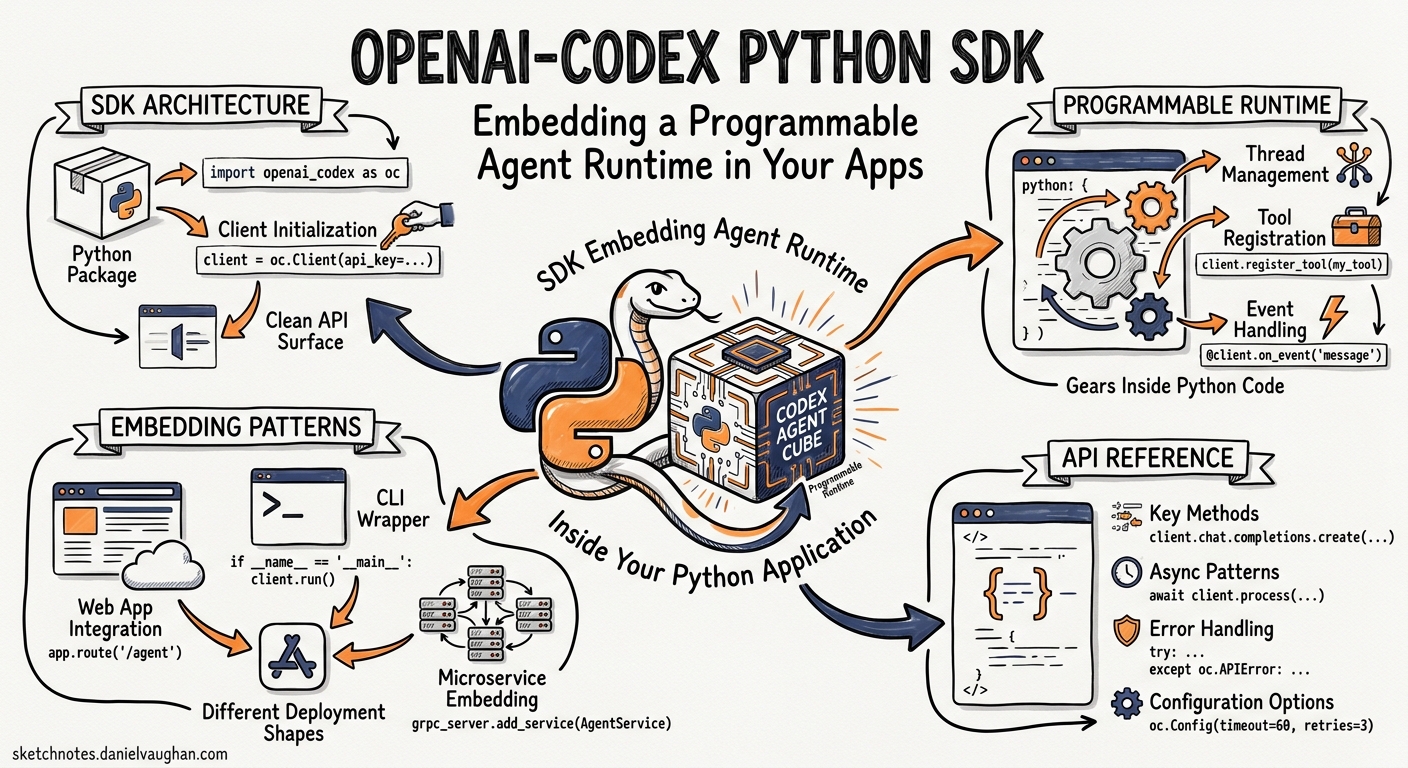
Most developers interact with Codex CLI through the TUI or codex exec. But a parallel effort has been landing in the openai/codex repository over the past week: an official openai-codex Python SDK that turns the Codex app-server into a fully programmable agent runtime you can embed in scripts, services, and orchestration platforms 1. The SDK reached its eighth merge commit on 12 May 2026 — renaming the package, defining the public API surface, generating types from the pinned runtime, adding approval mode controls, and wiring up an app-server integration harness 2.
This article covers the SDK’s architecture, its public API, practical patterns for embedding Codex in Python applications, and where it fits relative to codex exec and the MCP server surface.
Why a Python SDK?
The codex exec command is excellent for one-shot pipeline tasks, but it is fundamentally a CLI tool: you compose prompts as shell strings, parse JSON Lines from stdout, and handle errors via exit codes. For anything more sophisticated — multi-turn conversations, mid-turn steering, structured output extraction, thread lifecycle management, or embedding Codex inside a larger Python service — you need a native API 3.
The openai-codex package provides exactly that. It wraps the same app-server JSON-RPC v2 protocol that powers the Codex desktop app and IDE extensions, but exposes it as a typed Python client with Pydantic models, sync and async surfaces, and first-class error handling 1.
flowchart LR
    A[Your Python Code] -->|openai-codex SDK| B[App-Server Process]
    B -->|JSON-RPC v2 over stdio| C[Codex Runtime]
    C -->|Responses API| D[OpenAI Models]
    C -->|Sandbox| E[Local Filesystem]
Installation and Bootstrap
The SDK requires Python 3.10 or later and ships as two packages on PyPI 1:
openai-codex— the client library itselfopenai-codex-cli-bin— the platform-specific Codex binary, version-locked to the SDK
pip install openai-codex
The runtime binary package carries the correct native binary for your platform. The SDK version and runtime version must match — the dependency is pinned exactly 1. At the time of writing, the latest alpha is 0.131.0a4 4.
For development against a local Codex build, pass an explicit binary path:
from openai_codex import Codex
from openai_codex import AppServerConfig

config = AppServerConfig(codex_bin="/path/to/local/codex")
with Codex(config=config) as codex:
    ...
The Public API Surface
The SDK exports a deliberately small set of classes 1:
| Class | Purpose |
|---|---|
Codex |
Sync client — manages the app-server lifecycle |
AsyncCodex |
Async mirror of Codex |
Thread / AsyncThread |
A single conversation session |
TurnHandle / AsyncTurnHandle |
A running turn with streaming, steering, and interrupt controls |
RunResult |
Collected output from a completed turn |
AppServerConfig |
Binary path and startup configuration |
ApprovalMode |
High-level approval policy (deny_all, auto_review) |
Quickstart: One-Shot Turn
The minimal usage pattern mirrors what codex exec does, but from Python 1:
from openai_codex import Codex

with Codex() as codex:
    thread = codex.thread_start(model="gpt-5.4")
    result = thread.run("Explain how the transform module works.")
    print(result.final_response)
    print(f"Tokens used: {result.usage}")
Codex() is eager: it spawns the app-server process and completes the JSON-RPC initialize handshake in the constructor. The context manager ensures clean shutdown 1. thread.run() is the convenience method that starts a turn, collects all streamed events, and returns a RunResult containing the final response text, every ThreadItem produced during the turn, and token usage telemetry 5.
Multi-Turn Conversations
Unlike codex exec, the SDK makes multi-turn interaction natural:
from openai_codex import Codex

with Codex() as codex:
    thread = codex.thread_start(model="gpt-5.4")

    # First turn: gather context
    result = thread.run("Read src/auth.py and summarise the auth flow.")
    print(result.final_response)

    # Second turn: act on that context
    result = thread.run("Add rate limiting to the login endpoint.")
    print(f"Items produced: {len(result.items)}")
Each call to thread.run() appends to the existing conversation. The app-server maintains the full thread state, including tool call history and file edits 3.
Thread Lifecycle Management
The SDK exposes the full thread lifecycle 1:
# Resume a previous session
resumed = codex.thread_resume(
    thread_id="th_abc123",
    model="gpt-5.5",
    approval_mode=ApprovalMode.auto_review,
)

# Fork from an existing session
forked = codex.thread_fork(
    thread_id="th_abc123",
    developer_instructions="Focus only on test coverage.",
)

# Archive and unarchive
codex.thread_archive("th_abc123")
codex.thread_unarchive("th_abc123")

# List threads
threads = codex.thread_list(
    search_term="auth",
    limit=10,
)

# Compact a long thread
thread.compact()
Streaming and Turn Controls
For use cases that need real-time feedback — progress indicators, token-by-token rendering, or mid-turn redirection — the SDK provides thread.turn() instead of thread.run() 1:
from openai_codex import Codex

with Codex() as codex:
    thread = codex.thread_start(model="gpt-5.4")
    turn = thread.turn("Refactor the payment module into smaller services.")

    for event in turn.stream():
        print(f"[{event.method}] {type(event.payload).__name__}")
The event stream yields Notification objects. Key event types include 5:
item/completed— aThreadItem(message, tool call, file edit) has finishedturn/completed— the entire turn is donetoken_usage/updated— running token counts for cost tracking
Steering and Interruption
TurnHandle supports two real-time controls 1:
# Redirect the agent mid-turn (best-effort)
turn.steer("Actually, focus on the database layer first.")

# Cancel the current turn
turn.interrupt()
Steering is best-effort: the model may have already committed to a tool call. Interruption is immediate and terminates the turn.
Approval Modes
Production embeddings need programmatic approval control. The SDK provides ApprovalMode 6:
from openai_codex import Codex, ApprovalMode

# Deny all escalated permission requests
thread = codex.thread_start(
    approval_mode=ApprovalMode.deny_all,
    sandbox=SandboxMode.workspace_write,
)

# Let auto-review handle approvals
thread = codex.thread_start(
    approval_mode=ApprovalMode.auto_review,
)
deny_all maps to approval_policy=never — the agent never receives shell or network access beyond the sandbox baseline. auto_review delegates permission decisions to the Guardian reviewer 6. There is no approve_all mode in the SDK; granting blanket permission requires explicit CLI-level configuration, which is a deliberate safety constraint.
Structured Output
The SDK supports JSON Schema–constrained output at the turn level 1:
import json

schema = {
    "type": "object",
    "properties": {
        "summary": {"type": "string"},
        "risk_score": {"type": "number"},
        "files_changed": {
            "type": "array",
            "items": {"type": "string"},
        },
    },
    "required": ["summary", "risk_score", "files_changed"],
}

result = thread.run(
    "Analyse the last commit for security risks.",
    output_schema=schema,
)
report = json.loads(result.final_response)
print(f"Risk: {report['risk_score']}")
This is the SDK equivalent of codex exec --output-schema, but without the shell-quoting gymnastics 3.
Error Handling and Retry
The SDK defines a typed exception hierarchy rooted at AppServerError 7:
classDiagram
    AppServerError <|-- TransportClosedError
    AppServerError <|-- JsonRpcError
    JsonRpcError <|-- AppServerRpcError
    AppServerRpcError <|-- ParseError
    AppServerRpcError <|-- InvalidRequestError
    AppServerRpcError <|-- MethodNotFoundError
    AppServerRpcError <|-- InvalidParamsError
    AppServerRpcError <|-- InternalRpcError
    AppServerRpcError <|-- ServerBusyError
    ServerBusyError <|-- RetryLimitExceededError
For transient overload errors, the SDK provides a retry_on_overload helper with exponential back-off and jitter 7:
from openai_codex import Codex, retry_on_overload

with Codex() as codex:
    thread = codex.thread_start(model="gpt-5.4")
    result = retry_on_overload(
        lambda: thread.run("Generate the migration script."),
        max_attempts=3,
        initial_delay_s=0.25,
        max_delay_s=2.0,
    )
The is_retryable_error() function inspects JSON-RPC error data for server_overloaded signals, distinguishing transient load from permanent failures 7.
Async Parity
Every sync class has an async counterpart with identical API shape 1:
import asyncio
from openai_codex import AsyncCodex

async def main():
    async with AsyncCodex() as codex:
        thread = await codex.thread_start(model="gpt-5.4")
        result = await thread.run("List all TODO comments in the codebase.")
        print(result.final_response)

asyncio.run(main())
The async client initialises lazily on context entry or first awaited API use, which avoids blocking the event loop during import 1.
When to Use the SDK vs. codex exec vs. MCP Server
The three programmatic surfaces serve different use cases:
| Surface | Best for | Transport | State |
|---|---|---|---|
codex exec |
One-shot CI/CD tasks, shell pipelines | Shell process (stdin/stdout) | Stateless per invocation |
openai-codex SDK |
Multi-turn Python services, orchestration, custom UIs | JSON-RPC v2 over stdio | Full thread persistence |
codex mcp-server |
Multi-agent orchestration via OpenAI Agents SDK | MCP (JSON-RPC over stdio) | Thread per MCP session |
The SDK is the right choice when you need thread lifecycle control, mid-turn steering, typed error handling, or when your orchestration layer is already Python 3. The MCP server is better when you are composing Codex with other MCP-compatible agents via the Agents SDK 8.
Practical Pattern: Automated Code Review Service
Here is a more complete example combining several SDK features into an automated review pipeline:
from openai_codex import AsyncCodex, ApprovalMode
from openai_codex.api import ReasoningEffort
import asyncio, json

REVIEW_SCHEMA = {
    "type": "object",
    "properties": {
        "findings": {
            "type": "array",
            "items": {
                "type": "object",
                "properties": {
                    "severity": {"type": "string", "enum": ["P0", "P1", "P2"]},
                    "file": {"type": "string"},
                    "description": {"type": "string"},
                },
                "required": ["severity", "file", "description"],
            },
        },
        "summary": {"type": "string"},
    },
    "required": ["findings", "summary"],
}

async def review_diff(diff: str) -> dict:
    async with AsyncCodex() as codex:
        thread = await codex.thread_start(
            model="gpt-5.4",
            approval_mode=ApprovalMode.deny_all,
            developer_instructions="You are a code reviewer. Focus on bugs and security.",
        )
        result = await thread.run(
            f"Review this diff and report findings:\n\n{diff}",
            effort=ReasoningEffort.high,
            output_schema=REVIEW_SCHEMA,
        )
        return json.loads(result.final_response)
Current Limitations
The SDK is marked experimental and ships as alpha pre-releases 1. Several constraints apply:
- No PyPI stable release yet — the
0.131.0a4alpha is the latest available version 4 - stdio transport only — the SDK spawns a local app-server process; WebSocket and Unix socket transports are not yet exposed through the Python surface 1
- No approval callback —
ApprovalModeoffersdeny_allandauto_reviewbut no programmatic approval handler where your code decides per-request 6 ⚠️ - Platform binary coupling — the
openai-codex-cli-binpackage must match the SDK version exactly, and platform wheels are required for macOS (ARM64, x86_64), Linux (musl ARM64, x86_64), and Windows (ARM64, AMD64) 4 - No
codex execfeature parity — features like--ignore-user-config,--ignore-rules, and profile selection are not yet exposed as SDK parameters ⚠️
What Comes Next
The commit history suggests several directions 2:
- Stable release — the eight-commit merge sequence is the kind of API surface lockdown that precedes a
1.0or at least a non-alpha release - WebSocket transport — the app-server already supports WebSocket; the SDK client will likely gain a
ws://transport option - Richer approval callbacks — the current
ApprovalModeenum is explicitly described as “high-level”; a lower-level callback API would enable programmatic per-request decisions - TypeScript SDK — a
sdk/typescriptdirectory already exists in the repository 9
Citations
-
OpenAI, “openai-codex Python SDK README,”
sdk/python/README.md, openai/codex repository, May 2026. https://github.com/openai/codex/blob/main/sdk/python/README.md ↩ ↩2 ↩3 ↩4 ↩5 ↩6 ↩7 ↩8 ↩9 ↩10 ↩11 ↩12 ↩13 ↩14 ↩15 -
OpenAI, Codex repository commit history, “[1/8] Pin Python SDK runtime dependency” through “[8/8] Add Python SDK Ruff formatting,” merged May 2026. https://github.com/openai/codex/commits/main ↩ ↩2
-
OpenAI, “Non-interactive mode — Codex,” OpenAI Developers, May 2026. https://developers.openai.com/codex/noninteractive ↩ ↩2 ↩3 ↩4
-
OpenAI,
pyproject.tomlfor openai-codex,sdk/python/pyproject.toml, version0.131.0a4. https://github.com/openai/codex/blob/main/sdk/python/pyproject.toml ↩ ↩2 ↩3 -
OpenAI,
_run.py— RunResult and event collection,sdk/python/src/openai_codex/_run.py. https://github.com/openai/codex/blob/main/sdk/python/src/openai_codex/_run.py ↩ ↩2 -
OpenAI,
api.py— ApprovalMode enum and approval settings,sdk/python/src/openai_codex/api.py. https://github.com/openai/codex/blob/main/sdk/python/src/openai_codex/api.py ↩ ↩2 ↩3 -
OpenAI,
errors.pyandretry.py— exception hierarchy and retry_on_overload,sdk/python/src/openai_codex/. https://github.com/openai/codex/blob/main/sdk/python/src/openai_codex/errors.py ↩ ↩2 ↩3 -
OpenAI, “Use Codex with the Agents SDK,” OpenAI Developers, May 2026. https://developers.openai.com/codex/guides/agents-sdk ↩
-
OpenAI, Codex repository directory listing,
sdk/typescript/. https://github.com/openai/codex/tree/main/sdk/typescript ↩