Codex CLI for API-First Development: OpenAPI Spec Generation, Mock Servers, and Client SDK Automation
Codex CLI for API-First Development: OpenAPI Spec Generation, Mock Servers, and Client SDK Automation
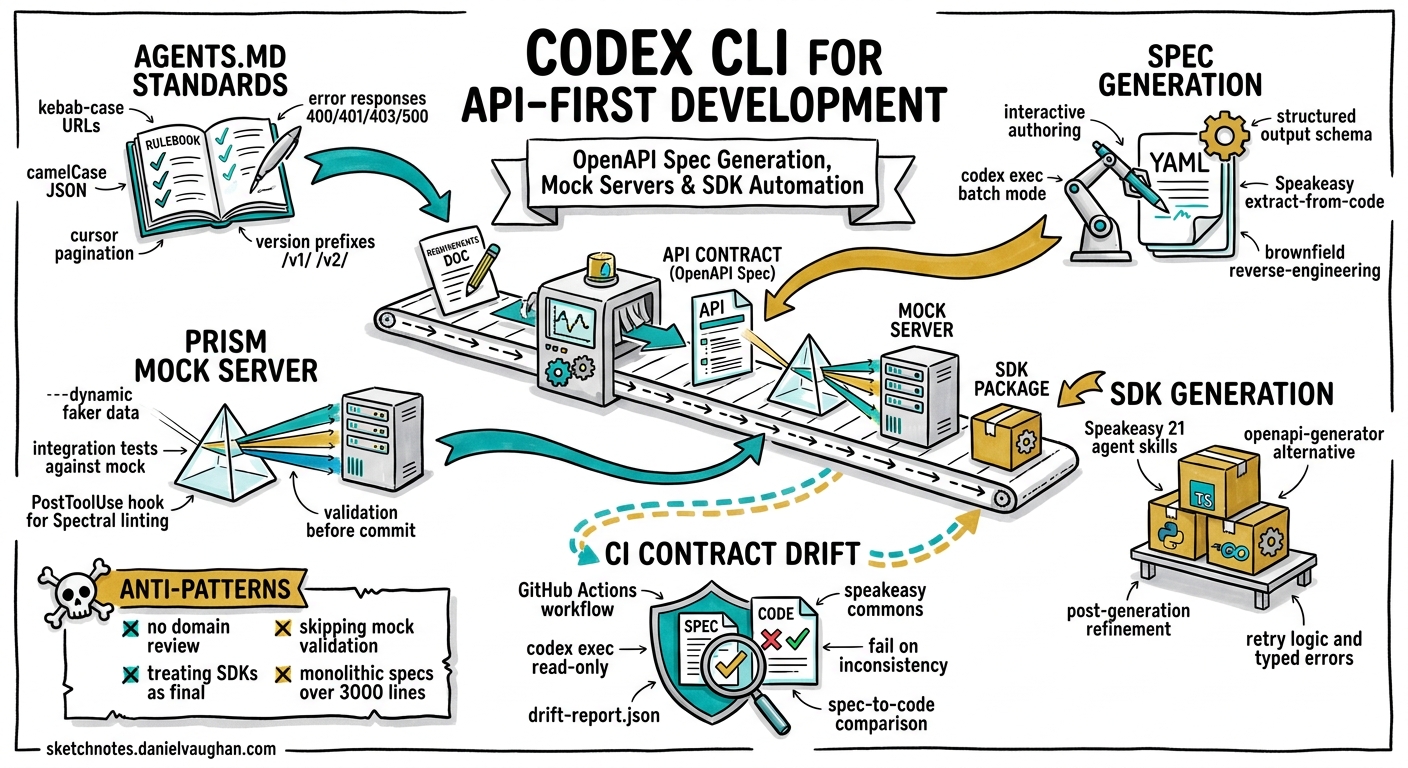
API-first development — writing the contract before the implementation — has been an industry best practice for years. Yet the gap between designing an OpenAPI spec and having a functioning mock server, validated contract, and generated SDKs still involves stitching together half a dozen tools manually. Codex CLI collapses that pipeline into a conversational workflow backed by structured output, agent skills, and CI enforcement.
This article walks through a complete API-first pipeline: from spec generation through mock validation, client SDK scaffolding, and contract drift detection in CI.
The API-First Pipeline with Codex CLI
flowchart LR
    A[Domain Requirements] --> B[AGENTS.md Constraints]
    B --> C[OpenAPI Spec Generation]
    C --> D[Prism Mock Server]
    C --> E[Client SDK Generation]
    D --> F[Contract Validation]
    E --> F
    F --> G[CI Enforcement Gate]
The pipeline has four stages: spec authoring, mock server provisioning, SDK generation, and continuous contract validation. Codex CLI can drive each stage interactively or in batch via codex exec.
Stage 1: Encoding API Standards in AGENTS.md
Before generating any specification, encode your organisation’s API design standards in AGENTS.md so every Codex session respects them 1:
<!-- AGENTS.md -->
## API Design Standards

- All new APIs MUST have an OpenAPI 3.1 specification in `specs/`
- Use kebab-case for URL paths, camelCase for JSON properties
- Every endpoint MUST define 400, 401, 403, and 500 error responses
- Pagination follows cursor-based pattern with `next_cursor` field
- All request/response schemas MUST include `example` values
- Version APIs via URL path prefix (`/v1/`, `/v2/`)
- Use `$ref` components for shared schemas — no inline definitions
Directory-scoped overrides let teams refine these standards per service 2:
repo-root/
├── AGENTS.md                    # Organisation-wide API standards
└── services/
    ├── payments/
    │   └── AGENTS.md            # PCI-DSS constraints for payment APIs
    └── notifications/
        └── AGENTS.md            # Async-first, webhook schema rules
Stage 2: Generating OpenAPI Specs with Codex CLI
Interactive Spec Authoring
For greenfield APIs, start an interactive session with architectural constraints:
codex "Design a REST API for a user management service. \
  Output an OpenAPI 3.1 spec in YAML to specs/users-api.yaml. \
  Include CRUD for users and teams, cursor-based pagination, \
  OAuth 2.0 bearer auth, and rate limiting headers."
Codex reads the AGENTS.md standards, generates a spec with proper error responses and examples, and writes it to disk 1. Review it in the TUI before accepting.
Batch Spec Generation with Structured Output
For CI pipelines or bulk generation, use codex exec with --output-schema to produce machine-readable results 3:
codex exec \
  --sandbox workspace-write \
  --output-schema specs/audit-schema.json \
  "Audit specs/users-api.yaml for OpenAPI 3.1 compliance. \
   Report missing examples, undocumented error codes, \
   and inline schema definitions that should be \$ref components."
Where audit-schema.json defines the expected output shape:
{
  "$schema": "https://json-schema.org/draft/2020-12/schema",
  "type": "object",
  "properties": {
    "spec_file": { "type": "string" },
    "violations": {
      "type": "array",
      "items": {
        "type": "object",
        "properties": {
          "path": { "type": "string" },
          "rule": { "type": "string" },
          "severity": { "enum": ["error", "warning", "info"] },
          "message": { "type": "string" }
        },
        "required": ["path", "rule", "severity", "message"]
      }
    },
    "summary": {
      "type": "object",
      "properties": {
        "total_endpoints": { "type": "integer" },
        "compliant": { "type": "integer" },
        "violations_count": { "type": "integer" }
      }
    }
  },
  "required": ["spec_file", "violations", "summary"]
}
Extracting Specs from Existing Code
For brownfield projects, Codex can reverse-engineer an OpenAPI spec from existing route handlers. The Speakeasy agent skills provide a dedicated extract-oas-from-code skill that pairs well with Codex CLI 4:
npx skills add speakeasy-api/skills
codex "Extract an OpenAPI 3.1 spec from the Express routes in src/routes/. \
  Use the speakeasy extract-oas-from-code skill. \
  Write the result to specs/extracted-api.yaml."
Stage 3: Mock Server with Prism
Once you have a spec, spin up a Stoplight Prism mock server for frontend teams to develop against 5:
# Install Prism
npm install -g @stoplight/prism-cli

# Start mock server from spec
prism mock specs/users-api.yaml --port 4010 --dynamic
The --dynamic flag uses Faker.js to generate realistic test data matching your schema definitions rather than returning static examples 5.
Codex-Driven Mock Validation
Use Codex to generate integration tests against the mock:
codex "Write integration tests in tests/api/ that exercise \
  every endpoint in specs/users-api.yaml against \
  http://localhost:4010. Use vitest and node-fetch. \
  Verify response shapes match the OpenAPI schemas. \
  Include edge cases for pagination cursors and error responses."
PostToolUse Hook for Spec Validation
Add a hook to validate specs whenever Codex modifies them:
# .codex/hooks.toml
[[post_tool_use]]
pattern = "specs/*.yaml"
command = "npx @stoplight/spectral-cli lint ${file} --ruleset .spectral.yaml"
on_failure = "block"
This prevents Codex from writing invalid specs — any Spectral rule violation blocks the change 6.
Stage 4: Client SDK Generation
Speakeasy Agent Skills
Speakeasy’s 21 agent skills include language-specific SDK generation for TypeScript, Python, Go, Java, C#, Ruby, and PHP 4. With the skills installed, Codex can generate SDKs conversationally:
codex "Generate a TypeScript client SDK from specs/users-api.yaml \
  using the Speakeasy SDK generation skill. \
  Output to packages/users-sdk-ts/. \
  Include retry logic and typed error classes."
openapi-generator as an Alternative
For teams not using Speakeasy, openapi-generator-cli remains a solid open-source option 7:
codex exec --sandbox workspace-write \
  "Run openapi-generator-cli generate \
   -i specs/users-api.yaml \
   -g typescript-axios \
   -o packages/users-client/ \
   --additional-properties=supportsES6=true,npmName=@acme/users-client. \
   Then review the generated code and fix any type issues."
The advantage of routing generation through Codex is post-generation refinement: the agent can review generated code, fix type issues, add missing JSDoc comments, and align naming with your project’s conventions — all in a single turn.
Reusable API-First Skill
Create a reusable skill at .agents/skills/api-first-auditor/SKILL.md:
---
name: api-first-auditor
description: >
  Audit OpenAPI specifications for completeness, generate mock server
  configurations, and scaffold client SDKs. Trigger when the user asks
  to review API specs, generate SDKs, or validate API contracts.
---

## Instructions

1. Validate the target OpenAPI spec with Spectral using `.spectral.yaml`
2. Check every endpoint has: error responses (400/401/403/500),
   request/response examples, and `$ref` component schemas
3. Verify pagination follows cursor-based pattern
4. Report findings as structured JSON matching `specs/audit-schema.json`
5. If `--fix` flag is provided, auto-remediate violations

## Tools Required
- `npx @stoplight/spectral-cli`
- `npx @openapitools/openapi-generator-cli`
Invoke it explicitly or let Codex match it implicitly when you mention API auditing 8.
CI Enforcement: Contract Drift Detection
The most valuable part of the pipeline is catching contract drift — when implementation diverges from the spec. Add a GitHub Actions workflow:
# .github/workflows/api-contract.yml
name: API Contract Validation
on:
  pull_request:
    paths:
      - 'specs/**'
      - 'src/routes/**'
      - 'packages/*-client/**'

jobs:
  contract-check:
    runs-on: ubuntu-latest
    steps:
      - uses: actions/checkout@v4

      - name: Lint OpenAPI specs
        run: npx @stoplight/spectral-cli lint specs/*.yaml --ruleset .spectral.yaml

      - name: Validate spec-to-code consistency
        env:
          CODEX_API_KEY: ${{ secrets.CODEX_API_KEY }}
        run: |
          codex exec \
            --sandbox read-only \
            --output-schema specs/drift-schema.json \
            -o drift-report.json \
            "Compare specs/users-api.yaml against the route handlers \
             in src/routes/users/. Report any endpoints, parameters, \
             or response schemas that exist in code but not in the spec, \
             or vice versa."

      - name: Fail on drift
        run: |
          DRIFT=$(jq '.drift_count' drift-report.json)
          if [ "$DRIFT" -gt 0 ]; then
            echo "::error::API contract drift detected: $DRIFT inconsistencies"
            jq '.drifts[]' drift-report.json
            exit 1
          fi
This uses codex exec with a CODEX_API_KEY access token for headless CI authentication 9, and structured output to produce a machine-readable drift report.
Model Selection
| Task | Recommended Model | Rationale |
|---|---|---|
| Interactive spec design | gpt-5.4 (default) |
Complex domain modelling benefits from strongest reasoning 10 |
| Batch spec auditing | gpt-5.4-mini |
Sufficient for structural validation; lower cost at scale |
| SDK review and refinement | gpt-5.4 |
Needs cross-file understanding of types and conventions |
| CI drift detection | gpt-5.4-mini |
Structured comparison task; cost-sensitive in CI |
Override per task with -c model=gpt-5.4-mini or set in your CI profile 10.
Anti-Patterns
Generating specs without domain review. Codex produces syntactically valid OpenAPI, but domain correctness requires human review. Never merge a generated spec without a domain expert approving the resource model.
Treating generated SDKs as final. Generated client code often needs refinement — retry policies, error handling conventions, and documentation rarely match your project’s standards out of the box. Use Codex for post-generation polish.
Skipping mock validation. A spec that passes linting may still produce unusable mock responses. Always test generated specs against Prism before committing.
Monolithic specs. For services with more than ~30 endpoints, split specs into domain-bounded files and use $ref across them. Single-file specs exceeding ~3,000 lines strain the context window.
Known Limitations
--output-schemaandresumeare mutually exclusive: structured output sessions cannot be resumed viacodex exec resume11- Sandbox network isolation: Prism mock servers running locally are not accessible from within the Codex sandbox; run validation outside the sandbox or use
danger-full-accessin trusted CI environments 3 - Context window for large specs: OpenAPI specs beyond ~2,000 lines may require splitting or summarisation before Codex can process them effectively
- Spectral custom rules: Codex can generate
.spectral.yamlrulesets but may produce rules using deprecated Spectral function syntax — validate generated rules manually
Citations
-
Custom instructions with AGENTS.md — Codex CLI, OpenAI Developers ↩ ↩2
-
AGENTS.md directory hierarchy and override rules — OpenAI Developers ↩
-
Agent skills for OpenAPI and SDK generation — Speakeasy ↩ ↩2
-
Prism — Open-Source HTTP Mock and Proxy Server, Stoplight ↩ ↩2
-
Features — Codex CLI, OpenAI Developers (hooks configuration) ↩
-
Command line options — Codex CLI Reference, OpenAI Developers ↩
-
Codex Changelog — OpenAI Developers (gpt-5.4 default model) ↩ ↩2
-
Add –output-schema support to codex exec resume — GitHub Issue #14343 ↩