GPT-5.3-Codex Deep Dive: Benchmarks, CLI Configuration, and Interactive Coding Workflows
GPT-5.3-Codex Deep Dive: Benchmarks, CLI Configuration, and Interactive Coding Workflows
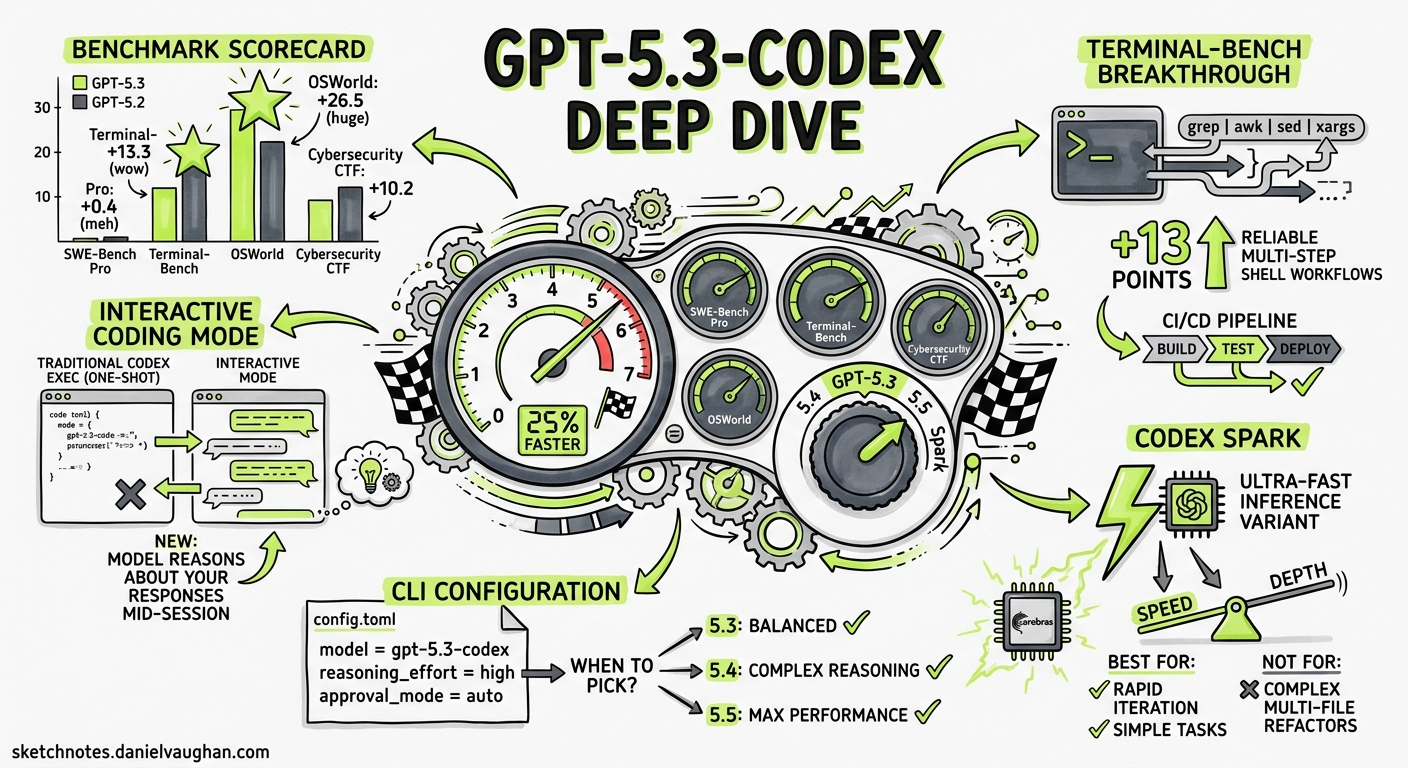
GPT-5.3-Codex landed on 5 February 2026 as OpenAI’s flagship coding model, promising industry-leading agentic performance alongside a 25 % speed improvement 1. Three months on, the model sits in a crowded lineup—GPT-5.4, GPT-5.4-mini, GPT-5.5, and the Cerebras-powered Spark variant all compete for the model = slot in your config.toml. This article dissects the benchmark numbers, walks through CLI configuration for daily use, and examines the interactive coding mode that makes GPT-5.3-Codex qualitatively different from its predecessors.
Benchmark Performance: Where GPT-5.3-Codex Actually Excels
The headline SWE-Bench Pro score—56.8 % versus GPT-5.2-Codex’s 56.4 %—is a 0.4-point delta that barely registers 2. The real story is elsewhere.
| Benchmark | GPT-5.3-Codex | GPT-5.2-Codex | Delta |
|---|---|---|---|
| SWE-Bench Pro (Public) | 56.8 % | 56.4 % | +0.4 |
| Terminal-Bench 2.0 | 77.3 % | 64.0 % | +13.3 |
| OSWorld-Verified | 64.7 % | 38.2 % | +26.5 |
| Cybersecurity CTF | 77.6 % | 67.4 % | +10.2 |
| SWE-Lancer IC Diamond | 81.4 % | 76.0 % | +5.4 |
| GDPval (wins or ties) | 70.9 % | 70.9 % | 0.0 |
Sources: OpenAI GPT-5.3-Codex announcement 1, independent analysis 2
Reading the Numbers
Terminal-Bench 2.0 (+13.3 points) measures complex terminal operations: multi-step shell workflows, piped command chains, and system administration tasks 2. A 13-point gain means GPT-5.3-Codex reliably handles terminal sequences that previously required human intervention—directly relevant to anyone running codex exec in CI/CD pipelines.
OSWorld-Verified (+26.5 points) evaluates computer-use tasks requiring multi-step reasoning across GUI and terminal environments 3. At 64.7 %, GPT-5.3-Codex sits within striking distance of the human baseline (~72 %), making it the first Codex model to approach human-level computer operation 3.
SWE-Bench Pro spans four programming languages rather than Python alone, testing production-style engineering across diverse codebases 2. The near-flat improvement here suggests GPT-5.3-Codex’s gains are concentrated in agentic capability—tool use, long-horizon planning, and environmental interaction—rather than raw code generation.
Token Efficiency
OpenAI claims GPT-5.3-Codex achieves its SWE-Bench Pro scores “with fewer output tokens than any prior model” 1. For teams billing by token, this matters: equivalent quality at lower cost per task. Combined with the 25 % inference speed improvement, the model delivers a meaningful reduction in both wall-clock time and spend per codex exec invocation.
CLI Configuration: Setting Up GPT-5.3-Codex
Basic Model Selection
Set GPT-5.3-Codex as your default in ~/.codex/config.toml:
model = "gpt-5.3-codex"
Or specify it per-invocation:
codex --model gpt-5.3-codex "Refactor the auth middleware"
Mid-session switching is available via the TUI:
/model gpt-5.3-codex
Reasoning Effort Tuning
GPT-5.3-Codex supports the full reasoning effort spectrum. A practical configuration separates planning from execution:
model = "gpt-5.3-codex"
model_reasoning_effort = "medium"
plan_mode_reasoning_effort = "high"
model_reasoning_summary = "concise"
This gives you deep reasoning during plan formulation (where correctness matters most) and efficient execution during implementation 4. The xhigh setting is available but model-dependent—test it on your specific workloads before committing to the token overhead.
Profile-Based Model Switching
For teams that need different models for different contexts, profiles allow per-project overrides:
[profiles.deep]
model = "gpt-5.3-codex"
model_reasoning_effort = "high"

[profiles.fast]
model = "gpt-5.4-mini"
model_reasoning_effort = "low"

[profiles.frontier]
model = "gpt-5.5"
model_reasoning_effort = "medium"
Launch with a profile:
codex --profile deep "Analyse the payment service for race conditions"
Context Window and Compaction
GPT-5.3-Codex operates within the standard context window configurable via model_context_window 5. For long sessions, tune the compaction threshold:
model_context_window = 128000
model_auto_compact_token_limit = 64000
tool_output_token_limit = 12000
The model’s improved token efficiency means sessions run longer before hitting compaction triggers—a tangible benefit for complex refactoring tasks that span many files.
Interactive Coding Mode: The Qualitative Shift
From Command-Response to Collaboration
GPT-5.3-Codex introduced a fundamentally different interaction pattern. Rather than submitting a prompt and waiting for a final output, the model provides continuous progress updates, discusses its approach, and accepts mid-execution steering 6.
sequenceDiagram
    participant Dev as Developer
    participant CLI as Codex CLI
    participant Model as GPT-5.3-Codex

    Dev->>CLI: "Migrate the user service to gRPC"
    CLI->>Model: Task submission
    Model-->>CLI: "Analysing current REST endpoints..."
    Model-->>CLI: "Found 12 endpoints. Proposing proto schema..."
    Dev->>CLI: "Use connect-go instead of grpc-go"
    Model-->>CLI: "Switching to connect-go. Updating imports..."
    Model-->>CLI: "Proto schema generated. Starting handlers..."
    Model->>CLI: Final implementation + diff
This mid-task steering capability means you catch architectural missteps early rather than reviewing a completed (but wrong) implementation 6.
Enabling Follow-Up Behaviour
In the Codex app, interactive mode is toggled via Settings > General > Follow-up behavior 6. In the CLI, the behaviour is active by default—the model streams progress updates to the TUI, and you can type follow-up instructions at any point during execution.
Practical Patterns
Checkpoint-and-redirect: Let the model work until it surfaces its plan, then adjust before implementation begins. This avoids wasted tokens on incorrect approaches.
Narrowing scope: Start with a broad instruction (“Improve error handling across the API layer”), observe which files the model targets, then constrain: “Focus on the payment endpoints only, skip the admin routes.”
Confirm-before-destructive: For operations that modify database schemas or configuration files, the interactive mode lets you verify the model’s understanding of the current state before it writes changes.
GPT-5.3-Codex vs the Current Lineup
With five models now available in Codex CLI, model selection is a genuine engineering decision 7:
graph TD
    A[Task Arrives] --> B{Complexity?}
    B -->|Simple, speed matters| C[GPT-5.4-mini]
    B -->|Standard coding| D{Budget?}
    B -->|Complex agentic| E{Frontier needed?}
    D -->|Cost-sensitive| C
    D -->|Quality-first| F[GPT-5.3-Codex]
    E -->|Yes| G[GPT-5.5]
    E -->|Terminal/agentic focus| F
    A --> H{Latency critical?}
    H -->|Sub-second needed| I[GPT-5.3-Codex-Spark]
| Model | Sweet Spot | Trade-off |
|---|---|---|
| GPT-5.5 | Complex multi-step, research, computer use | Highest cost per token |
| GPT-5.4 | General professional coding | Superseded by 5.5 where available |
| GPT-5.4-mini | Fast subagent tasks, simple edits | Lower ceiling on complex reasoning |
| GPT-5.3-Codex | Terminal-heavy, agentic workflows, CI/CD | Narrower than 5.5 on general tasks |
| GPT-5.3-Codex-Spark | Real-time iteration, pair programming | Text-only, 128k context, Pro-only 8 |
When GPT-5.3-Codex Still Wins
Despite GPT-5.5’s arrival, GPT-5.3-Codex remains the pragmatic choice for:
- CI/CD pipelines where the Terminal-Bench advantage translates to more reliable
codex execruns 2 - Cost-conscious teams where token efficiency matters more than frontier capability
- Terminal-native workflows where the 77.3 % Terminal-Bench score directly maps to daily usage
- Agentic automation where long-horizon tool use outweighs raw generation quality
GPT-5.3-Codex-Spark: The Cerebras Variant
Released alongside GPT-5.3-Codex, the Spark variant runs on Cerebras Wafer-Scale Engine 3 hardware, delivering over 1,000 tokens per second 8. This is OpenAI’s first model not running on Nvidia infrastructure.
Current Limitations
- Text-only: No image input or generation
- 128k context window: Adequate for most sessions but constrained for massive monorepo operations
- Research preview: Available only to ChatGPT Pro subscribers
- No API access: Currently limited to the app, CLI, and VS Code extension 8
CLI Configuration
model = "gpt-5.3-codex-spark"
Spark excels at rapid iteration loops—the sub-100ms latency makes the CLI feel like an extension of your own typing rather than a request-response cycle. Pair it with low reasoning effort for maximum speed:
model = "gpt-5.3-codex-spark"
model_reasoning_effort = "low"
⚠️ Spark’s speed advantage is most pronounced for short, focused tasks. For multi-file refactoring or complex architectural work, the full GPT-5.3-Codex or GPT-5.5 will produce better results despite higher latency.
Non-Interactive Automation with GPT-5.3-Codex
The Terminal-Bench improvements make GPT-5.3-Codex particularly effective in codex exec pipelines:
# CI/CD: generate a migration summary with structured output
codex exec \
  --model gpt-5.3-codex \
  --json \
  --output-schema '{"type":"object","properties":{"breaking_changes":{"type":"array","items":{"type":"string"}},"risk_level":{"type":"string","enum":["low","medium","high"]},"summary":{"type":"string"}},"required":["breaking_changes","risk_level","summary"]}' \
  "Analyse the diff in this PR and identify breaking changes" < pr_diff.txt
The --output-schema flag enforces a JSON shape on the final response, making downstream pipeline integration deterministic 9. GPT-5.3-Codex’s improved terminal comprehension means fewer malformed outputs and more reliable schema conformance compared to earlier models.
Structured Output for Release Automation
codex exec \
  --model gpt-5.3-codex \
  -e medium \
  --output-last-message \
  "Generate release notes from the git log since the last tag" \
  2>/dev/null
The -e medium flag sets reasoning effort inline, useful when you want different effort levels per pipeline stage without maintaining separate config files 4.
Recommendations
-
Default to GPT-5.5 for interactive development where budget permits—it subsumes GPT-5.3-Codex’s capabilities and adds computer use, multimodal input, and stronger planning 7.
-
Use GPT-5.3-Codex for CI/CD where the Terminal-Bench advantage and token efficiency directly reduce pipeline cost and failure rate.
-
Reserve Spark for rapid iteration cycles—linting, small fixes, quick explanations—where latency matters more than depth.
-
Set
plan_mode_reasoning_effort = "high"regardless of which model you choose. Planning quality disproportionately affects overall task success. -
Profile your actual costs. GPT-5.3-Codex’s token efficiency claim is aggregate; your specific workloads may differ. Use
codex exec --jsonto capture per-task token counts and build your own cost model 9.
Citations
-
Introducing GPT-5.3-Codex — OpenAI — Official announcement, 5 February 2026 ↩ ↩2 ↩3
-
GPT-5.3-Codex Performance Analysis: SWE-Bench Pro, Terminal-Bench 2.0, OSWorld Results — Pooya Golchian — Independent benchmark analysis ↩ ↩2 ↩3 ↩4 ↩5
-
GPT-5.3 Codex: Features, Benchmarks, and Migration Guide — Digital Applied — Technical deep dive with benchmark tables ↩ ↩2
-
Configuration Reference — Codex CLI — OpenAI Developers — Official config.toml reference ↩ ↩2
-
Sample Configuration — Codex CLI — OpenAI Developers — Complete sample config.toml ↩
-
GPT-5.3-Codex Powers Interactive Coding Agents — Auto-Post — Interactive mode analysis ↩ ↩2 ↩3
-
Models — Codex — OpenAI Developers — Current model lineup and recommendations ↩ ↩2
-
Introducing GPT-5.3-Codex-Spark — OpenAI — Spark variant announcement ↩ ↩2 ↩3
-
Non-interactive mode — Codex — OpenAI Developers — codex exec and structured output documentation ↩ ↩2