The April 2026 Model Deprecation Wave: Migrating Your Codex CLI Configuration
The April 2026 Model Deprecation Wave: Migrating Your Codex CLI Configuration
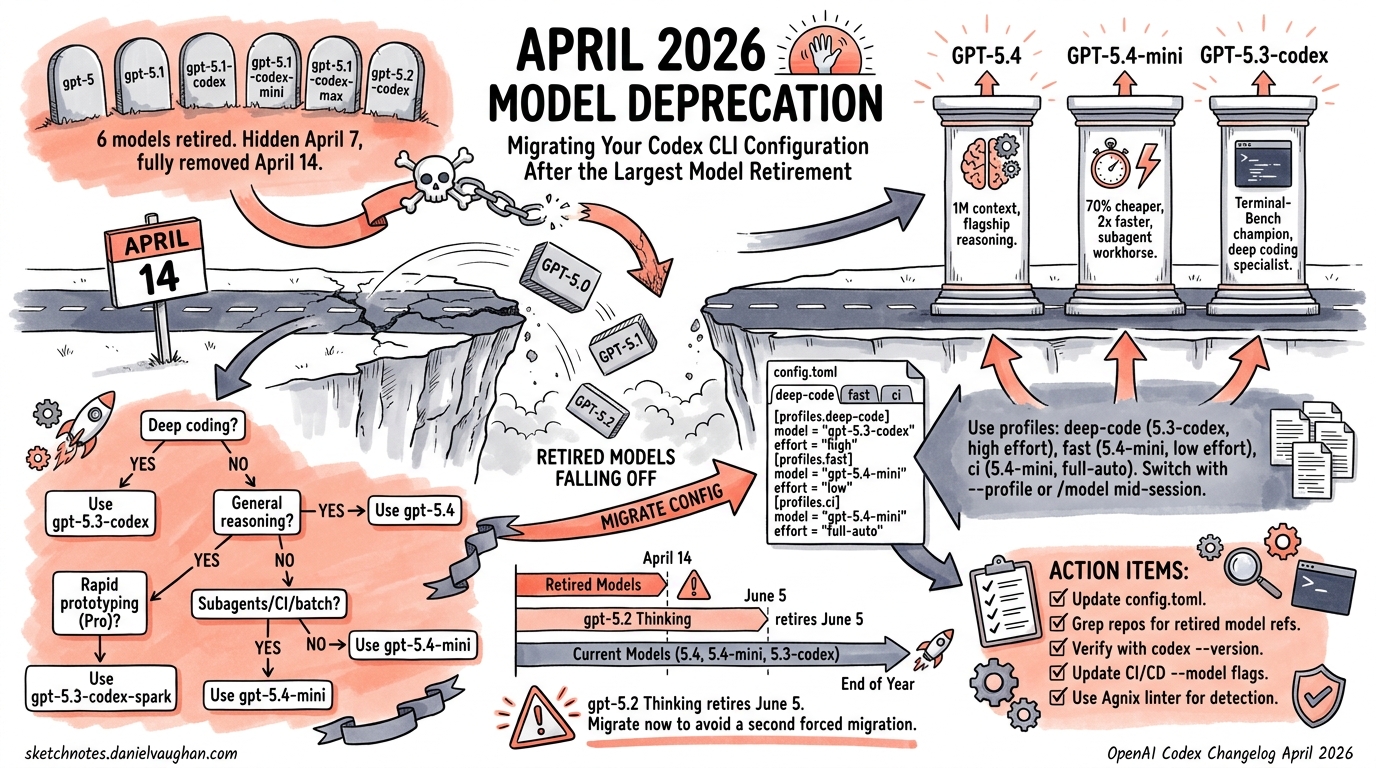
On 14 April 2026, OpenAI completed the largest model retirement in Codex CLI’s history. Six models — gpt-5.2-codex, gpt-5.1-codex-mini, gpt-5.1-codex-max, gpt-5.1-codex, gpt-5.1, and gpt-5 — were removed from the ChatGPT sign-in model picker 1. If your config.toml still references any of them, your sessions are either failing or silently falling back to a default you didn’t choose. This article covers exactly what changed, what’s still available, and how to update your configuration for the post-deprecation landscape.
What Was Removed and Why
The retirement rolled out in two phases 1:
| Date | Action |
|---|---|
| 7 April 2026 | Models hidden from the model picker UI |
| 14 April 2026 | Models fully removed for ChatGPT sign-in users |
The six retired models span three generations:
- GPT-5.0: The original GPT-5, now superseded twice over
- GPT-5.1 family:
gpt-5.1,gpt-5.1-codex,gpt-5.1-codex-mini,gpt-5.1-codex-max— the first Codex-specialised variants - GPT-5.2 family:
gpt-5.2-codex— the model that introduced native context compaction 2
The strategic rationale is straightforward: GPT-5.4 incorporates the frontier coding capabilities of GPT-5.3-Codex into a single mainline reasoning model 3. Maintaining six legacy model endpoints that fewer than 8% of active sessions still used (per the Discussion #17038 deprecation notice 4) was no longer justifiable.
The API Escape Hatch
Critically, this deprecation only affects ChatGPT sign-in users. If you authenticate with an API key, you can still access gpt-5.2 and gpt-5.1 models via the API — OpenAI has announced no API retirement date for these 5. The gpt-5.2-codex and gpt-5.1-codex-* variants, however, are fully deprecated across both surfaces.
The Current Model Lineup
After the April 14 retirement, five models remain available in Codex CLI 6:
| Model | Context | Input Cost | Output Cost | Best For |
|---|---|---|---|---|
gpt-5.4 |
1.0M tokens | $2.50/MTok | $15.00/MTok | General-purpose flagship; coding + reasoning + computer use |
gpt-5.4-mini |
400K tokens | $0.75/MTok | $4.50/MTok | Fast iteration, subagents, lightweight tasks |
gpt-5.3-codex |
400K tokens | $1.75/MTok | $14.00/MTok | Terminal-first deep coding; highest Terminal-Bench score |
gpt-5.3-codex-spark |
128K tokens | Research preview | Research preview | Near-instant iteration at 1,000+ tok/s (Pro only) |
gpt-5.2 |
200K tokens | Legacy pricing | Legacy pricing | Legacy; retires from ChatGPT on 5 June 2026 |
⚠️ gpt-5.2 Thinking remains accessible in the Legacy Models section for paid ChatGPT users, but retires on 5 June 2026 3. If you’re still on gpt-5.2, migrate now rather than facing a second forced migration in seven weeks.
Model Selection Decision Framework
The post-deprecation landscape simplifies the decision to three practical choices. gpt-5.3-codex-spark is a specialist tool for Pro subscribers, and gpt-5.2 is on borrowed time.
flowchart TD
    A[New Codex CLI Session] --> B{Task type?}
    B -->|Deep coding / refactoring| C{Budget priority?}
    B -->|General reasoning + coding| D[gpt-5.4]
    B -->|Subagent / batch / CI| E[gpt-5.4-mini]
    B -->|Rapid prototyping / drafts| F{Pro subscriber?}
    C -->|Performance| D
    C -->|Cost| G[gpt-5.3-codex]
    F -->|Yes| H[gpt-5.3-codex-spark]
    F -->|No| E

    style D fill:#2d6a4f,color:#fff
    style G fill:#1b4332,color:#fff
    style E fill:#40916c,color:#fff
    style H fill:#52b788,color:#000
GPT-5.4 vs GPT-5.3-Codex: The Nuanced Choice
These two models are closer in coding performance than you might expect 7:
- SWE-Bench Pro: GPT-5.4 leads narrowly at 57.7% vs 56.8%
- Terminal-Bench 2.0: GPT-5.3-Codex leads at 77.3% vs 75.1% — the benchmark most relevant to CLI users
- OSWorld (computer use): GPT-5.4 dominates at 75% vs 64%, crossing the human expert baseline of 72.4%
- Context window: GPT-5.4 offers 1.0M tokens vs 400K — significant for monorepo work
The practical rule: if you’re doing pure terminal-first coding and want to save 30% on input tokens, gpt-5.3-codex remains the better choice 7. For everything else — especially workflows involving computer use, knowledge work, or sessions approaching 400K tokens — gpt-5.4 is the stronger default.
GPT-5.4-mini: The Subagent Workhorse
At $0.75 per million input tokens, gpt-5.4-mini is 70% cheaper than gpt-5.4 and runs over 2× faster 8. It approaches gpt-5.4 performance on SWE-Bench Pro and OSWorld-Verified 8, making it the clear choice for:
- Subagent workers in multi-agent orchestration
- CI/CD pipeline tasks via
codex exec - Batch processing with
spawn_agents_on_csv - Any high-volume, latency-sensitive workflow
Updating Your Configuration
Basic Migration
If your config.toml references a retired model, update it:
# Before (broken after April 14)
model = "gpt-5.2-codex"

# After — choose your default
model = "gpt-5.4"
Profile-Based Model Routing
The deprecation is a good prompt to adopt profiles if you haven’t already. Define task-appropriate model selections rather than a single global default 9:
# ~/.codex/config.toml

model = "gpt-5.4"
approval_policy = "on-request"

[profiles.deep-code]
model = "gpt-5.3-codex"
model_reasoning_effort = "high"

[profiles.fast]
model = "gpt-5.4-mini"
model_reasoning_effort = "low"

[profiles.ci]
model = "gpt-5.4-mini"
approval_policy = "full-auto"
model_reasoning_effort = "medium"
Switch between them at launch:
# Deep refactoring session
codex --profile deep-code

# Quick CI fix
codex --profile ci

# Or override inline
codex --model gpt-5.4-mini
You can also switch mid-session with the /model command 9 — useful when you start a session in planning mode with gpt-5.4 and want to hand off implementation to a cheaper model.
Multi-Agent Configuration Updates
If you’re running multi-agent workflows with TOML-defined subagents, ensure every agent block specifies a current model. Subagents that inherited a now-retired model from a parent configuration will fail silently or fall back unpredictably:
# In your orchestrator's agent TOML
[[agents]]
name = "implementer"
model = "gpt-5.4-mini"        # Explicit — don't rely on inheritance
model_reasoning_effort = "medium"
instructions_file = "AGENTS.md"

[[agents]]
name = "reviewer"
model = "gpt-5.4"             # Flagship for review quality
model_reasoning_effort = "high"
API Key Users: Keeping Access to Legacy Models
If you need gpt-5.2 via the API (for reproducibility, regression testing, or gradual migration), configure a model provider with your API key 10:
model = "gpt-5.2"
model_provider = "openai-api"

[model_providers.openai-api]
name = "OpenAI API (direct)"
base_url = "https://api.openai.com/v1"
env_key = "OPENAI_API_KEY"
⚠️ This is a temporary measure. Plan your migration to gpt-5.4 or gpt-5.3-codex before the API deprecation announcement arrives.
The Deprecation Timeline at a Glance
gantt
    title Codex Model Availability Timeline (2026)
    dateFormat YYYY-MM-DD
    axisFormat %b %d

    section Retired
    gpt-5.1 family (Codex picker)   :done, 2026-01-01, 2026-04-14
    gpt-5.2-codex (Codex picker)    :done, 2026-01-01, 2026-04-14
    gpt-5 (Codex picker)            :done, 2026-01-01, 2026-04-14

    section Retiring Soon
    gpt-5.2 Thinking (Legacy)       :active, 2026-04-14, 2026-06-05

    section Current
    gpt-5.4                         :2026-03-05, 2026-12-31
    gpt-5.4-mini                    :2026-03-05, 2026-12-31
    gpt-5.3-codex                   :2026-01-14, 2026-12-31
    gpt-5.3-codex-spark (Pro)       :2026-02-12, 2026-12-31
Verifying Your Migration
After updating config.toml, verify your configuration is clean:
# Check which model your default profile uses
codex --model gpt-5.4 --version

# Verify each profile loads correctly
codex --profile deep-code --version
codex --profile ci --version

# Check mid-session with /status
# (inside a session, /status shows the active model and rate limits)
If you use Agnix for configuration linting, update to v0.18.0+ which includes CDX-CFG-042: a rule that flags references to retired models 11.
What This Means for the Ecosystem
The April deprecation wave signals OpenAI’s consolidation strategy: fewer, more capable models rather than a sprawling family tree 3. GPT-5.4 absorbs the specialist coding capabilities that previously required a dedicated -codex variant. The only remaining specialist is gpt-5.3-codex, which survives because it still holds the Terminal-Bench crown 7 and powers the Spark real-time inference pathway.
For teams, the consolidation simplifies model governance. Instead of managing policies across six models with varying capability profiles, enterprise requirements.toml files can now restrict to three: gpt-5.4 for production work, gpt-5.4-mini for automation, and gpt-5.3-codex for teams that need the terminal-first edge.
For CI/CD pipelines, audit your GitHub Actions workflows and codex exec scripts. Any --model flag referencing a retired model will cause immediate failures. A quick grep across your repositories saves a production incident:
# Find references to retired models in your codebase
grep -rn 'gpt-5\.\(0\|1\|2-codex\)' \
  --include='*.toml' --include='*.yml' --include='*.yaml' \
  --include='*.sh' --include='*.md'
Citations
-
Codex Changelog — April 2026 — Model picker and retirement timeline details. ↩ ↩2
-
Codex Model Lineage: The Context Compaction Breakthrough — GPT-5.2-Codex native compaction history. ↩
-
Introducing GPT-5.4 — OpenAI — GPT-5.4 launch announcement, consolidation of coding capabilities, GPT-5.2 Thinking retirement date. ↩ ↩2 ↩3
-
Codex model deprecations — Discussion #17038 — Community discussion and usage statistics. ↩
-
OpenAI API Deprecations — API-level model retirement schedule. ↩
-
Models — Codex Developer Docs — Current model lineup and recommendations. ↩
-
GPT-5.4 vs GPT-5.3 Codex: Should Developers Upgrade? — Benchmark comparison data. ↩ ↩2 ↩3
-
Introducing GPT-5.4 mini and nano — OpenAI — GPT-5.4-mini performance and pricing. ↩ ↩2
-
Config Basics — Codex Developer Docs — Profile system and model switching. ↩ ↩2
-
Advanced Configuration — Codex Developer Docs — Model provider configuration. ↩
-
Agnix: Linting Your Codex CLI Agent Configurations — Configuration linting with retired model detection. ⚠️ CDX-CFG-042 rule existence unverified. ↩