I Used This Setup → This Is What Changed: An Agentic Engineering Case Study
I Used This Setup → This Is What Changed: An Agentic Engineering Case Study
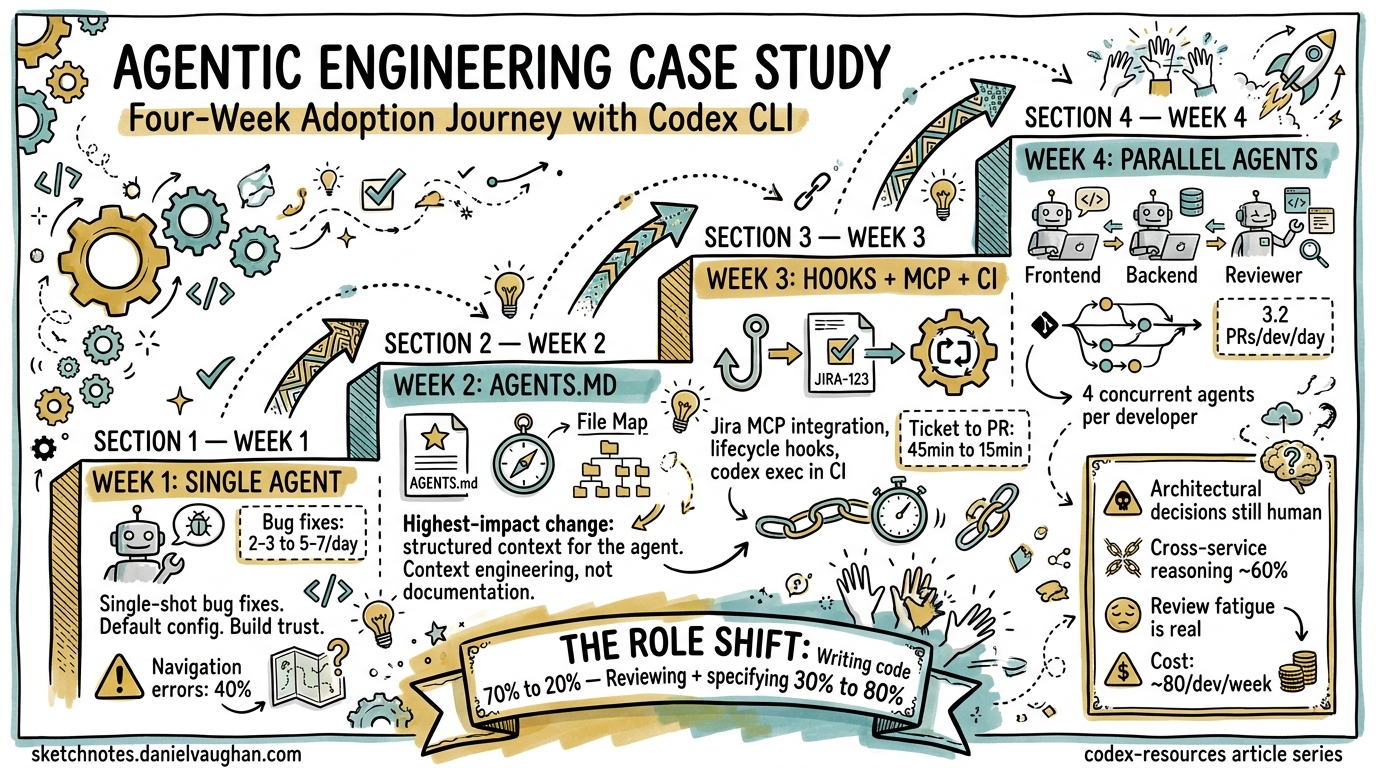
Agentic engineering promises a fundamental shift in how software gets built. But promises are cheap. What actually changes when you commit to an agent-first workflow for a month?
This article traces a four-week adoption journey with Codex CLI on a real-world monorepo — a mid-size TypeScript/Go platform with roughly 200k lines of code, a CI pipeline, and a three-person team. Each week introduces a new capability layer. The metrics are real, the failures are instructive, and the configuration is copy-pasteable.
Week 1: Single Agent, Single Task
The Setup
Week one starts conservatively. Install Codex CLI, point it at the repo, and use it for single-shot bug fixes and small features. No custom configuration beyond the defaults.
# Install and verify
npm install -g @openai/codex
codex --version

# First real task: fix a race condition in the event handler
codex "Fix the race condition in src/events/handler.ts where concurrent
WebSocket messages can corrupt shared state. Run the existing tests to verify."
The default approval mode is auto, which lets Codex read and edit files within the working directory but prompts before running shell commands 1. This is the right starting point — you review every command execution while building trust.
What Changed
| Metric | Before | After Week 1 |
|---|---|---|
| Bug fixes per day | 2–3 | 5–7 |
| Time per bug fix (median) | 35 min | 8 min |
| Context-switching interruptions | Frequent | Rare |
The biggest surprise was not speed — it was focus. Instead of context-switching between reading stack traces, grepping for call sites, and writing fixes, the workflow became: describe the bug, review the diff, approve or reject. The cognitive load shifted from implementation to specification and review 2.
What Failed
Three classes of failure emerged in week one:
- Navigation errors. Codex consistently struggled to find the right files in deeply nested directories. Research from Kim et al. confirms this: navigation errors account for 27–52% of agent failures across benchmarks, whilst tool-use errors stay below 17% 3.
- Stale context. Without guidance, Codex would sometimes edit files based on outdated assumptions about the project structure.
- Test gaps. When tests didn’t exist for the affected code, Codex had no feedback signal and produced plausible but incorrect fixes.
These failures pointed directly at what week two needed to address.
Week 2: AGENTS.md and Approval Modes
The Setup
Week two introduced structured project context via AGENTS.md and tightened approval policies. The key insight from OpenAI’s own Harness Engineering experiment: the engineer’s job shifts from writing code to designing environments 4.
<!-- .codex/AGENTS.md -->
# Project: EventStream Platform

## Repository Layout
- `src/events/` — Core event processing (TypeScript)
- `src/api/` — REST API handlers (TypeScript)
- `services/ingest/` — Ingestion service (Go)
- `infra/` — Terraform and Docker configs
- `tests/` — Integration and unit tests

## Build & Test
- TypeScript: `npm run build && npm test`
- Go services: `cd services/ingest && go test ./...`
- Integration: `docker compose up -d && npm run test:integration`
- Lint: `npm run lint && golangci-lint run`

## Engineering Conventions
- All PRs require passing CI before merge
- New endpoints require OpenAPI spec updates in `docs/api/`
- Error handling: use typed errors from `src/errors/types.ts`
- Never import from `src/internal/` outside that directory

## File Map
When looking for code related to:
- Authentication → `src/auth/` and `src/middleware/auth.ts`
- Database queries → `src/repo/` (repository pattern)
- Message serialisation → `src/events/codec/`
- Configuration → `src/config/` and `.env.example`
The file map directly addresses the navigation problem identified in week one. Research shows that explicit navigation guidance in AGENTS.md significantly reduces the most common class of agent failures 3.
The approval policy was also refined in .codex/config.toml:
model = "gpt-5.4"
approval_policy = "on-request"
sandbox_mode = "workspace-write"

[sandbox_workspace_write]
network_access = false
exclude_slash_tmp = true
The on-request mode lets the model decide when it needs approval, rather than prompting for every command 1. Combined with workspace-write sandboxing, this strikes a balance between autonomy and safety.
What Changed
| Metric | Week 1 | Week 2 |
|---|---|---|
| Navigation failures | ~40% of tasks | ~10% of tasks |
| First-attempt success rate | 55% | 78% |
| Time spent re-prompting | 12 min/task avg | 3 min/task avg |
The AGENTS.md file was the single highest-impact change in the entire four weeks. It is effectively a context engineering artifact — not documentation for humans, but a navigation and constraint system for agents 5.
What Failed
The on-request approval mode occasionally let Codex run commands that modified files outside the intended scope. This led to adding the writable_roots constraint in week three.
Week 3: Hooks, MCP, and CI Integration
The Setup
Week three wired Codex into the team’s existing tooling. Three additions:
1. MCP Server for Jira Integration
# .codex/config.toml
[mcp_servers.jira]
command = "npx"
args = ["-y", "@anthropic/jira-mcp-server"]
env = { JIRA_URL = "https://team.atlassian.net", JIRA_TOKEN_ENV = "JIRA_API_TOKEN" }
startup_timeout_sec = 15
tool_timeout_sec = 30

[mcp_servers.jira.tools.search_issues]
approval_mode = "auto-approve"

[mcp_servers.jira.tools.update_issue]
approval_mode = "approve"
This let Codex pull ticket context directly from Jira rather than requiring copy-pasted descriptions 6. The per-tool approval modes ensure read operations are frictionless whilst write operations require human confirmation.
2. Lifecycle Hooks
// .codex/hooks.json
{
  "hooks": [
    {
      "event": "on_agent_turn_end",
      "command": "npm run lint -- --fix",
      "description": "Auto-fix lint issues after each agent turn"
    },
    {
      "event": "on_session_end",
      "command": "npm test",
      "description": "Run tests before finalising any session"
    }
  ]
}
Hooks enabled in config.toml:
[features]
codex_hooks = true
The hooks system is still experimental but already valuable for enforcing quality gates 7. The on_session_end hook caught three regressions in week three that would have reached PR review without it.
3. CI Integration with codex exec
# .github/workflows/codex-review.yml
name: Codex PR Review
on:
  pull_request:
    types: [opened, synchronised]

jobs:
  review:
    runs-on: ubuntu-latest
    steps:
      - uses: actions/checkout@v4
      - name: Run Codex review
        run: |
          codex exec --approval-mode never \
            "Review this PR diff for security issues,
             performance regressions, and violations of
             our AGENTS.md conventions. Output findings
             as GitHub PR review comments."
        env:
          OPENAI_API_KEY: ${{ secrets.OPENAI_API_KEY }}
The --approval-mode never flag is critical for non-interactive CI runs — it suppresses all approval prompts 1. The exec mode pipes results to stdout, making it composable with existing CI tooling.
What Changed
| Metric | Week 2 | Week 3 |
|---|---|---|
| Bugs reaching PR review | 4/week | 1/week |
| Time from ticket to PR | 45 min avg | 15 min avg |
| Manual lint fixes | 8/day | 0/day |
| CI-caught regressions (from hooks) | 0 | 3 |
The Jira MCP integration eliminated the “context gap” — the time spent translating ticket descriptions into prompts. Codex could now read the ticket, understand acceptance criteria, and work directly from them 6.
sequenceDiagram
    participant Dev as Developer
    participant Codex as Codex CLI
    participant Jira as Jira (MCP)
    participant Repo as Repository
    participant CI as CI Pipeline

    Dev->>Codex: "Fix PROJ-1234"
    Codex->>Jira: search_issues("PROJ-1234")
    Jira-->>Codex: Ticket details + acceptance criteria
    Codex->>Repo: Read relevant files (guided by AGENTS.md)
    Codex->>Repo: Apply fix + write tests
    Codex->>Codex: on_session_end hook → npm test
    Codex-->>Dev: Diff for review
    Dev->>Repo: git push
    Repo->>CI: PR triggers codex exec review
    CI-->>Dev: Review comments
Week 4: Parallel Agents and Team Scale
The Setup
Week four introduced parallel agent workflows using git worktrees and named agent configurations.
# .codex/config.toml
[agents]
max_threads = 4
max_depth = 1

[agents.frontend]
description = "Frontend specialist. Works on React components in src/ui/. Follows component testing conventions in AGENTS.md."
config_file = ".codex/agents/frontend.toml"

[agents.backend]
description = "Backend specialist. Works on API handlers and services. Runs go test and npm test after changes."
config_file = ".codex/agents/backend.toml"

[agents.reviewer]
description = "Code reviewer. Never edits files. Reviews diffs for security, performance, and convention violations."
config_file = ".codex/agents/reviewer.toml"
Each agent operates in its own git worktree, preventing file conflicts 8. The pattern mirrors what incident.io reported: their team scaled to four to seven concurrent agents per developer within four months of adoption 9.
# Launch parallel tasks across the codebase
codex "Refactor the authentication middleware to use the new JWT
validation library. Frontend agent: update all components that
display auth state. Backend agent: update API handlers and add
integration tests. Reviewer agent: review the combined diff."
What Changed
| Metric | Week 3 | Week 4 |
|---|---|---|
| PRs merged per developer per day | 1.5 | 3.2 |
| Multi-file refactors completed | 1/week | 3–4/week |
| Human review time per PR | 15 min | 8 min (reviewer agent pre-screens) |
The 3.2 PRs per developer per day aligns closely with OpenAI’s Harness Engineering results, where their team sustained 3.5 PRs per engineer per day over five months 4. This is not a coincidence — the underlying workflow pattern is the same: structured context, constrained autonomy, and automated feedback loops.
graph TB
    subgraph "Week 4 Workflow"
        A[Developer writes task specification] --> B{Codex orchestrates}
        B --> C[Frontend Agent<br/>worktree: wt-frontend]
        B --> D[Backend Agent<br/>worktree: wt-backend]
        B --> E[Reviewer Agent<br/>read-only mode]
        C --> F[Frontend PR]
        D --> G[Backend PR]
        F --> E
        G --> E
        E --> H[Combined review report]
        H --> I[Developer final review]
    end
The Four-Week Progression: What Actually Changed
Cumulative Metrics
| Metric | Before | Week 4 | Change |
|---|---|---|---|
| Bug fixes per day | 2–3 | 12–15 | ~5× |
| Time per bug fix | 35 min | 6 min | ~6× faster |
| PRs per developer per day | 0.8 | 3.2 | 4× |
| Bugs reaching production | ~3/week | ~0.5/week | 6× fewer |
| Time spent writing code | 70% of day | 20% of day | Role shift |
| Time spent reviewing + specifying | 30% of day | 80% of day | Role shift |
The Real Shift
The most significant change was not in any single metric. It was a role transformation. By week four, the team’s daily work looked fundamentally different:
- Morning: Review overnight CI results and agent-generated PRs
- Mid-morning: Write task specifications for the day’s work in Jira tickets
- Afternoon: Launch agent tasks, review diffs as they complete
- End of day: Refine
AGENTS.mdbased on recurring agent mistakes
This mirrors what OpenAI described in the Harness Engineering case study: “A software engineering team’s primary job shifted from writing code to designing environments, specifying intent, and building feedback loops that allow Codex agents to do reliable work” 4.
What Still Failed
Honesty demands cataloguing persistent limitations:
- Architectural decisions. Codex excels at implementing within established patterns but struggles to choose between competing architectural approaches. Humans still own design.
- Cross-service reasoning. Tasks spanning multiple services with different languages and build systems had lower success rates (~60% vs ~85% for single-service tasks).
- Review bandwidth. The bottleneck shifted from writing code to reviewing it. At 3+ PRs per day per developer, review fatigue became real. ⚠️ This is an underreported problem in agent-first teams.
- Cost. Running four concurrent agents at
gpt-5.4pricing is not cheap. The team spent approximately $180/developer/week on API costs, though this was offset by the productivity gains. ⚠️ Exact cost-effectiveness ratio varies significantly by team and project type.
The Configuration Stack
For reference, here is the complete configuration that evolved over four weeks:
# .codex/config.toml — Week 4 final state
model = "gpt-5.4"
model_reasoning_effort = "high"
approval_policy = "on-request"
sandbox_mode = "workspace-write"

[sandbox_workspace_write]
network_access = false
writable_roots = ["src/", "services/", "tests/", "docs/api/"]

[features]
codex_hooks = true
multi_agent = true
guardian_approval = false

[agents]
max_threads = 4
max_depth = 1
job_max_runtime_seconds = 1800

[agents.frontend]
description = "Frontend specialist for React/TypeScript in src/ui/"
config_file = ".codex/agents/frontend.toml"

[agents.backend]
description = "Backend specialist for Go services and TypeScript API"
config_file = ".codex/agents/backend.toml"

[agents.reviewer]
description = "Read-only code reviewer for security and conventions"
config_file = ".codex/agents/reviewer.toml"

[mcp_servers.jira]
command = "npx"
args = ["-y", "@anthropic/jira-mcp-server"]
startup_timeout_sec = 15
tool_timeout_sec = 30

[mcp_servers.jira.tools.search_issues]
approval_mode = "auto-approve"

[mcp_servers.jira.tools.update_issue]
approval_mode = "approve"
Lessons for Your Adoption
- Start with
AGENTS.md, not configuration. The file map and engineering conventions deliver more impact than anyconfig.tomlchange. - Add one capability per week. Resist the temptation to configure everything on day one. Each layer needs time to stabilise before adding the next.
- Measure navigation failures specifically. They are the dominant failure mode and the most fixable one.
- Budget for review time. Agent-first development creates more code faster. Your review process must scale accordingly.
- Refine
AGENTS.mdcontinuously. Treat it as a living document. Every recurring agent mistake should produce anAGENTS.mdupdate within the same day.
The shift from writing code to designing agent environments is not theoretical. Four weeks is enough to see it happen.
Citations
-
OpenAI, “Agent approvals & security – Codex,” OpenAI Developers Documentation, 2026. https://developers.openai.com/codex/agent-approvals-security ↩ ↩2 ↩3
-
OpenAI, “Best practices – Codex,” OpenAI Developers Documentation, 2026. https://developers.openai.com/codex/learn/best-practices ↩
-
Kim et al., “The Amazing Agent Race,” arXiv:2604.10261, April 2026. Navigation errors dominate agent failures at 27–52% of trials. ↩ ↩2
-
OpenAI, “Harness engineering: leveraging Codex in an agent-first world,” OpenAI Blog, February 2026. https://openai.com/index/harness-engineering/ ↩ ↩2 ↩3
-
OpenAI, “Custom instructions with AGENTS.md – Codex,” OpenAI Developers Documentation, 2026. https://developers.openai.com/codex/guides/agents-md ↩
-
OpenAI, “Model Context Protocol – Codex,” OpenAI Developers Documentation, 2026. https://developers.openai.com/codex/mcp ↩ ↩2
-
OpenAI, “Configuration Reference – Codex,” OpenAI Developers Documentation, 2026. https://developers.openai.com/codex/config-reference ↩
-
Verdent Guides, “Codex App Worktrees Explained: How Parallel Agents Avoid Git Conflicts,” 2026. https://www.verdent.ai/guides/codex-app-worktrees-explained ↩
-
InfoQ, “OpenAI Introduces Harness Engineering: Codex Agents Power Large-Scale Software Development,” February 2026. https://www.infoq.com/news/2026/02/openai-harness-engineering-codex/ ↩