Open-Weight Models for Codex CLI: Choosing the Right Local Coding Agent in 2026
Open-Weight Models for Codex CLI: Choosing the Right Local Coding Agent in 2026
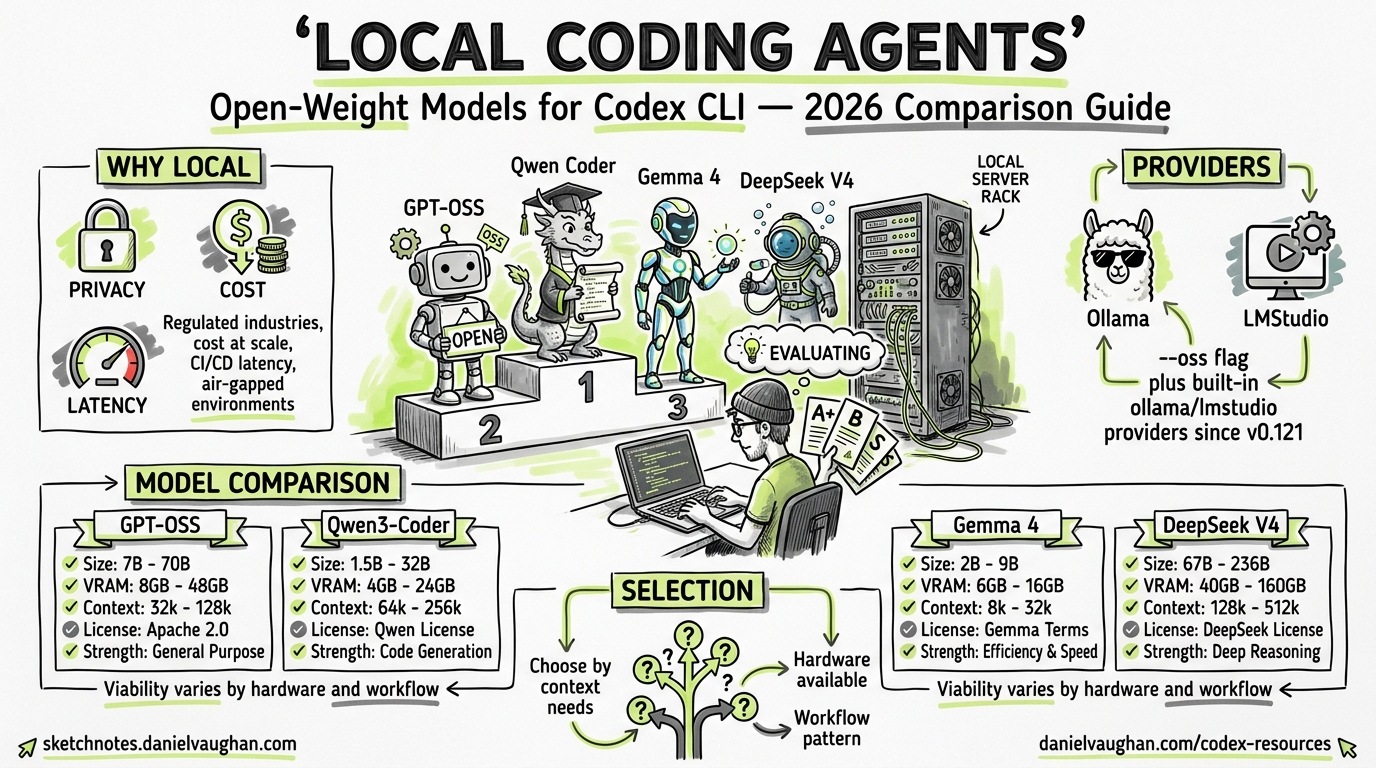
The open-weight model landscape for agentic coding has shifted dramatically in the past six months. OpenAI’s GPT-OSS family, Qwen’s Coder-Next, Google’s Gemma 4, and DeepSeek V4 all claim to be viable local alternatives for Codex CLI — but their real-world suitability varies enormously depending on your hardware, context needs, and workflow patterns. This article provides a practical selection guide for senior developers who want to run Codex CLI against local models without the hand-waving.
Why Run Codex CLI Locally?
Three forces are driving local model adoption:
- Privacy and compliance — regulated industries (finance, defence, healthcare) cannot send proprietary code to external APIs1
- Cost at scale — GPT-5.5 charges a 2× credit multiplier versus GPT-5.42; teams running dozens of daily sessions can accumulate significant spend
- Latency and availability — local inference eliminates network round-trips and API rate limits, critical for CI/CD pipelines and air-gapped environments3
Codex CLI has supported local providers since early 2025, but the --oss flag and built-in ollama/lmstudio providers (stabilised in v0.121.04) make the experience first-class rather than a workaround.
The --oss Flag and Provider Architecture
When you launch codex --oss, Codex CLI switches from the OpenAI API to a local provider5. The default behaviour depends on your config.toml:
# ~/.codex/config.toml
oss_provider = "ollama"   # or "lmstudio"
If oss_provider is unset, Codex prompts you to choose between Ollama and LM Studio interactively5. For automated workflows, always set this explicitly.
You can also define custom providers for other inference engines:
[model_providers.vllm]
name = "vLLM Local"
base_url = "http://localhost:8000/v1"
env_key = "VLLM_API_KEY"
wire_api = "responses"

[profiles.local-deepseek]
model_provider = "vllm"
model = "deepseek-v4-flash"
Launch with codex --profile local-deepseek to use the profile6.
The Contenders: Open-Weight Models for Agentic Coding
quadrantChart
    title Model Selection: Active Parameters vs SWE-Bench Verified
    x-axis "Fewer Active Params" --> "More Active Params"
    y-axis "Lower SWE-Bench" --> "Higher SWE-Bench"
    quadrant-1 "High quality, high cost"
    quadrant-2 "Efficiency sweet spot"
    quadrant-3 "Lightweight but limited"
    quadrant-4 "Resource-heavy, underwhelming"
    "GPT-OSS-120B": [0.35, 0.72]
    "GPT-OSS-20B": [0.20, 0.45]
    "Qwen3-Coder-Next": [0.15, 0.80]
    "Gemma 4 31B": [0.55, 0.70]
    "Gemma 4 26B MoE": [0.30, 0.68]
    "DeepSeek V4-Pro": [0.75, 0.82]
    "DeepSeek V4-Flash": [0.25, 0.60]
GPT-OSS (OpenAI)
OpenAI’s first open-weight models, released under Apache 2.0 in August 20257:
| Variant | Total Params | Active Params | Min RAM | SWE-Bench Verified |
|---|---|---|---|---|
| GPT-OSS-20B | 21B | 3.6B | 16 GB | ⚠️ ~45% (estimated) |
| GPT-OSS-120B | 117B | 5.1B | 80 GB | 62.4%8 |
Both use Mixture-of-Experts (MoE) architecture with MXFP4 quantisation7. The 120B variant fits on a single H100 or MI300X. The key limitation is the default context window of 8,192 tokens7 — significantly below what complex agentic workflows demand. You must explicitly extend this via your inference engine.
Codex CLI setup (Ollama):
ollama pull gpt-oss:120b
codex --oss -m gpt-oss:120b
Or via config profile:
[profiles.gpt-oss]
model_provider = "ollama"
model = "gpt-oss:120b"
model_reasoning_effort = "high"
Best for: Teams already invested in the OpenAI ecosystem wanting a local fallback with familiar model behaviour.
Qwen3-Coder-Next (Alibaba)
The standout efficiency leader, released February 20269:
| Variant | Total Params | Active Params | Context | SWE-Bench Verified |
|---|---|---|---|---|
| 30B (A3B) | 30B | 3B | 256K | ~73.4%10 |
| 480B (A35B) | 480B | 35B | 256K | ⚠️ Higher (exact score unconfirmed) |
Qwen3-Coder-Next achieves 74.2% on SWE-Bench Verified with only 3B active parameters9 — a remarkable efficiency ratio. Its 256K native context window (extendable to 1M with YaRN9) makes it the only local model that comfortably handles repository-scale context without aggressive compaction.
Codex CLI setup (Ollama):
ollama pull qwen3-coder:30b
codex --oss -m qwen3-coder:30b
Codex CLI setup (LM Studio):
lms load qwen/qwen3-coder-30b --context-length 65536
lms server start
[model_providers.lm_studio]
name = "LM Studio"
base_url = "http://localhost:1234/v1"

[profiles.qwen3-local]
model_provider = "lm_studio"
model = "qwen/qwen3-coder-30b"
Best for: Developers with consumer hardware (8–16 GB VRAM) who need strong agentic coding with long context.
Gemma 4 (Google)
Google’s open-weight family with a breakthrough in tool-calling reliability11:
| Variant | Params | Architecture | SWE-Bench Verified |
|---|---|---|---|
| 26B MoE | 26B | MoE | ⚠️ ~97% of 31B quality |
| 31B Dense | 31B | Dense | ~70% (estimated from agent benchmarks)11 |
Gemma 4’s key differentiator is first-class tool-calling tokens (fc_call, fc_call_name, fc_call_reason, fc_response) baked into the vocabulary11. Previous open-weight models relied on prompt hacks for tool use; Gemma 4 natively understands tool-call structure, jumping from 6.6% to 86.4% on agent benchmarks versus Gemma 311.
Codex CLI setup (MLX on Apple Silicon):
pip install mlx-lm
mlx_lm.server --model google/gemma-4-26b-it-mlx --port 8888
[model_providers.mlx]
name = "MLX LM"
base_url = "http://localhost:8888/v1"

[profiles.gemma4-local]
model_provider = "mlx"
model = "google/gemma-4-26b-it-mlx"
Best for: Apple Silicon users wanting reliable tool-calling without quantisation trade-offs.
DeepSeek V4 (DeepSeek AI)
The heavyweight contender, released in early 202612:
| Variant | Total Params | Active Params | Context | SWE-Bench Pro |
|---|---|---|---|---|
| V4-Flash | 284B | 13B | 1M | ⚠️ Strong but unconfirmed exact score |
| V4-Pro | 1.6T | 49B | 1M | 55.4%12 |
DeepSeek V4 boasts a 1M-token context window and MLA compression that enables inference on a single RTX 409012. However, the Pro variant’s 1.6T total parameters mean full-precision serving requires serious infrastructure.
Best for: Teams with dedicated GPU infrastructure needing maximum context window and raw coding ability.
Decision Framework
flowchart TD
    A[Choose a local model for Codex CLI] --> B{Hardware?}
    B -- "Apple Silicon / 16GB" --> C{Context needs?}
    B -- "Single GPU 24GB+" --> D{Priority?}
    B -- "Server 80GB+" --> E[GPT-OSS-120B or DeepSeek V4-Flash]
    C -- "< 32K tokens" --> F["Gemma 4 26B MoE via MLX"]
    C -- "> 32K tokens" --> G["Qwen3-Coder-Next 30B"]
    D -- "Efficiency" --> G
    D -- "Tool-calling reliability" --> H["Gemma 4 31B Dense"]
    D -- "Long context" --> I["Qwen3-Coder-Next 30B or DeepSeek V4-Flash"]
Quick Recommendations
| Scenario | Recommended Model | Rationale |
|---|---|---|
| Consumer laptop, general coding | Qwen3-Coder-Next 30B | 3B active params, 256K context, 74.2% SWE-Bench |
| Apple Silicon, tool-heavy workflows | Gemma 4 26B MoE | Native tool tokens, excellent MLX support |
| Enterprise air-gapped server | GPT-OSS-120B | OpenAI ecosystem familiarity, Apache 2.0 |
| Maximum context, dedicated GPU | DeepSeek V4-Flash | 1M context, 13B active, strong coding |
| CI/CD pipeline, minimal resources | GPT-OSS-20B | 3.6B active, 16 GB RAM, fast inference |
Context Window: The Hidden Bottleneck
Context window is the single most important differentiator for agentic coding. Codex CLI’s agent loop accumulates context rapidly — file reads, shell outputs, tool results, and reasoning all consume tokens. The official recommendation is at least 32K tokens3, but complex sessions routinely exceed 64K.
| Model | Default Context | Configurable Maximum |
|---|---|---|
| GPT-OSS-120B | 8,192 | ⚠️ Engine-dependent |
| Qwen3-Coder-Next 30B | 256,000 | 1,000,000 (YaRN) |
| Gemma 4 31B | 32,768 | ⚠️ Limited scaling |
| DeepSeek V4-Flash | 1,000,000 | 1,000,000 |
GPT-OSS’s 8K default is a significant limitation for Codex workflows. Ollama users must explicitly raise it:
ollama run gpt-oss:120b
/set parameter num_ctx 65536
For LM Studio, set context length at model load time:
lms load gpt-oss:120b --context-length 65536
Performance Tuning for Codex CLI
Reasoning Effort
Local models benefit from matching reasoning effort to task complexity. Since v0.124.0, Codex CLI supports Alt+, and Alt+. shortcuts to adjust reasoning effort in the TUI4:
# Per-profile reasoning tuning
[profiles.local-fast]
model_provider = "ollama"
model = "qwen3-coder:30b"
model_reasoning_effort = "low"

[profiles.local-deep]
model_provider = "ollama"
model = "qwen3-coder:30b"
model_reasoning_effort = "high"
Prompt Caching
Local inference engines do not benefit from OpenAI’s server-side prompt caching. However, vLLM’s prefix caching and Ollama’s KV cache persistence provide similar benefits for repeated prefixes13. Keep your AGENTS.md and system prompt stable across sessions to maximise cache hits.
Batch Mode
For CI/CD, codex exec with a local provider eliminates API costs entirely:
codex exec --profile local-fast \
  --output-schema ./review-schema.json \
  "Review the changes in this PR for security issues" \
  -o ./review-output.json
Hybrid Strategies: Cloud + Local
The most practical approach for many teams combines cloud and local models:
flowchart LR
    A[Developer Workflow] --> B{Task type?}
    B -- "Complex refactoring" --> C["GPT-5.5 via OpenAI API"]
    B -- "Quick edits / reviews" --> D["Qwen3-Coder-Next local"]
    B -- "CI/CD automated checks" --> E["GPT-OSS-120B local"]
    B -- "Air-gapped environment" --> F["Qwen3-Coder-Next local"]
Configure multiple profiles in config.toml and switch with --profile:
# Cloud profile (default)
model = "gpt-5.5"
model_provider = "openai"

# Local profiles
[profiles.local]
model_provider = "ollama"
model = "qwen3-coder:30b"

[profiles.ci]
model_provider = "ollama"
model = "gpt-oss:120b"
model_reasoning_effort = "low"
# Interactive work — cloud
codex "refactor the auth module to use OAuth 2.1"

# Quick local review
codex --profile local "review this diff for bugs"

# CI pipeline — free
codex exec --profile ci "check for security vulnerabilities"
Known Limitations and Gotchas
- Harmony response format — GPT-OSS models require the harmony response format to function correctly; standard chat templates produce degraded output7
- Tool-calling variance — not all local models handle Codex’s tool-call protocol equally. Gemma 4’s native tokens give it an edge; GPT-OSS and Qwen rely on prompt-based tool formatting11
- MCP server compatibility — local models with small context windows may struggle with MCP-heavy workflows where tool schemas consume significant prompt space14
- Memory system limitations — Codex’s built-in memory system uses specific models for extraction and consolidation; these default to OpenAI-hosted models and may not work offline without explicit overrides15
- Plugin marketplace — plugin installation and marketplace browsing require internet connectivity regardless of model provider3
What to Watch
The local model landscape is moving fast. Key developments to track:
- Qwen3.6-35B-A3B (April 2026) further improves on Qwen3-Coder-Next’s efficiency, scoring 73.4% on SWE-Bench Verified with the same 3B active parameter budget10
- GPT-OSS-Safeguard variants add safety reasoning capabilities for enterprise compliance scenarios16
- Codex CLI
/modelcommand now supports switching between local providers mid-session (Issue #17261)17, reducing the friction of hybrid workflows
For teams evaluating local models today, Qwen3-Coder-Next 30B offers the best balance of quality, efficiency, and context capacity. Gemma 4 wins on tool-calling reliability. GPT-OSS provides the safest choice for teams already deep in the OpenAI ecosystem. The right answer depends on your constraints — but the era of “local models are too weak for agents” is definitively over.
Citations
-
OpenAI, “Agent approvals & security – Codex,” https://developers.openai.com/codex/agent-approvals-security ↩
-
OpenAI, “Introducing GPT-5.5,” April 23, 2026, https://openai.com/index/introducing-gpt-5-5/ ↩
-
D. Vaughan, “Codex CLI Offline Mode: Local Models, Air-Gapped Setups, and What Works Without Internet,” April 18, 2026, https://codex.danielvaughan.com/2026/04/18/codex-cli-offline-local-models-air-gapped-guide/ ↩ ↩2 ↩3
-
OpenAI, “Changelog – Codex,” https://developers.openai.com/codex/changelog ↩ ↩2
-
OpenAI, “Configuration Reference – Codex,” https://developers.openai.com/codex/config-reference ↩ ↩2
-
OpenAI, “Advanced Configuration – Codex,” https://developers.openai.com/codex/config-advanced ↩
-
OpenAI, “Introducing gpt-oss,” August 2025, https://openai.com/index/introducing-gpt-oss/ ↩ ↩2 ↩3 ↩4
-
Clarifai, “OpenAI GPT-OSS Benchmarks: How It Compares to GLM-4.5, Qwen3, DeepSeek, and Kimi K2,” https://www.clarifai.com/blog/openai-gpt-oss-benchmarks-how-it-compares-to-glm-4.5-qwen3-deepseek-and-kimi-k2 ↩
-
Qwen Team, “Qwen3-Coder: Agentic Coding in the World,” https://qwen.ai/blog?id=qwen3-coder ↩ ↩2 ↩3
-
Qwen Team, “Qwen3.6-35B-A3B: Agentic Coding Power, Now Open to All,” https://qwen.ai/blog?id=qwen3.6-35b-a3b ↩ ↩2
-
D. Vaughan, “Gemma 4 Local Model + Codex CLI: Complete Setup Guide,” April 10, 2026, https://codex.danielvaughan.com/2026/04/10/gemma-4-local-model-codex-cli-complete-setup-guide/ ↩ ↩2 ↩3 ↩4 ↩5
-
NxCode, “DeepSeek V4 (2026): 1T Parameters, 81% SWE-bench, $0.30/MTok — Full Specs,” https://www.nxcode.io/resources/news/deepseek-v4-release-specs-benchmarks-2026 ↩ ↩2 ↩3
-
S. Jagtap, “Codex CLI: Running GPT-OSS and Local Coding Models with Ollama, LM Studio, and MLX,” https://dev.to/shashikant86/codex-cli-running-gpt-oss-and-local-coding-models-with-ollama-lm-studio-and-mlx-403g ↩
-
D. Vaughan, “MCP Schema Bloat and System Prompt Tax: Performance Impact of Tool Definitions,” April 23, 2026, https://codex.danielvaughan.com/2026/04/23/mcp-schema-bloat-system-prompt-tax-tool-definition-performance/ ↩
-
OpenAI, “Memories – Codex,” https://developers.openai.com/codex/memories ↩
-
OpenAI, “Introducing gpt-oss-safeguard,” https://openai.com/index/introducing-gpt-oss-safeguard/ ↩
-
GitHub Issue #17261, “feat: /model support for LM Studio and Ollama local model switching,” https://github.com/openai/codex/issues/17261 ↩